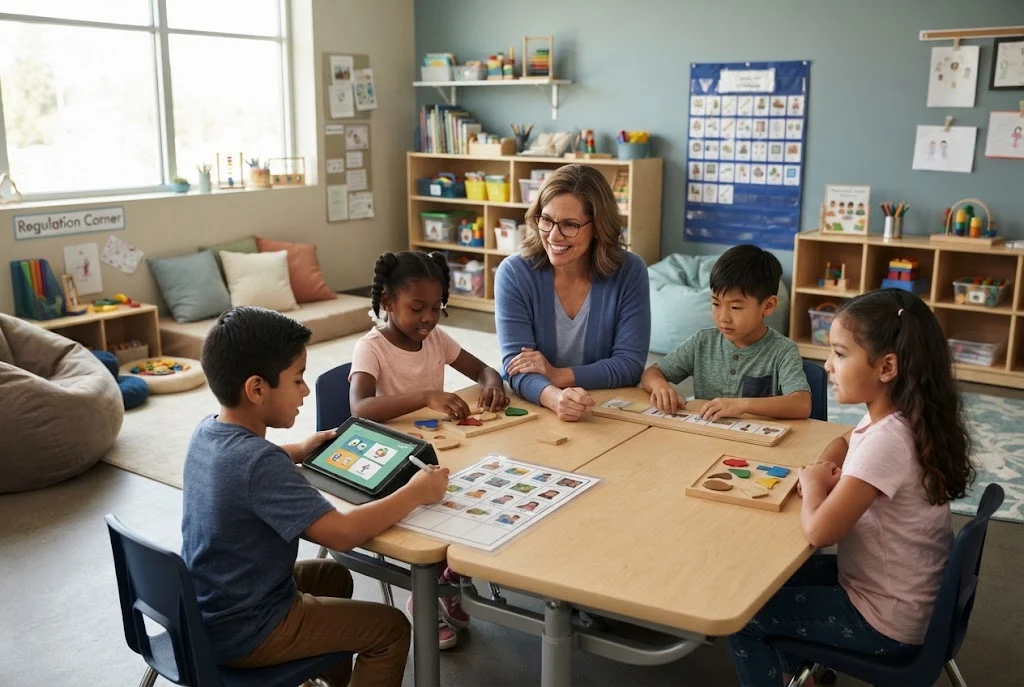
Transforming learning experiences in special education starts with understanding individual needs and then connecting those needs to thoughtful instruction, accessible classroom design, appropriate technology, positive relationships, progress monitoring, and collaboration with families. When these elements work together, educators can create learning environments that are more responsive, predictable, inclusive, and engaging.
Understanding the Needs of Students in a Special Education Classroom
Every student brings a different combination of strengths, challenges, interests, communication styles, and learning preferences to the classroom. Two students with the same disability category may still require very different instructional supports.
For that reason, educators need to observe how students respond to lessons, classroom routines, sensory input, peer interactions, transitions, and different types of learning materials. These observations can help teachers identify barriers to participation and determine which supports may make instruction more accessible.
A thoughtful classroom may include visual schedules, quiet spaces, adapted seating, hands-on materials, communication supports, assistive technology, and clearly defined activity areas. The goal is not to make every classroom feature identical, but to create an environment that helps students participate with greater confidence and independence.
Professionals involved in assessment and educational planning can also contribute valuable perspectives. Understanding the role of an education diagnostician can help readers see how assessment information can contribute to understanding individual learning needs.
Using Evidence-Based Instructional Strategies
Effective special education instruction should be informed by evidence, student data, professional expertise, and the needs of the individual learner. The U.S. Department of Education describes evidence-based decision-making as a process that includes identifying needs, selecting appropriate practices, implementing them, and examining results over time.
In the classroom, this means teachers should not assume that one strategy will work equally well for every student. Instead, instructional approaches can be introduced, monitored, evaluated, and adjusted when the available evidence shows that a change is needed.
Differentiated Instruction
Differentiated instruction allows teachers to adjust content, learning activities, pacing, materials, and demonstrations of understanding. A student may need simplified directions, additional modeling, visual examples, extended time, or opportunities to demonstrate learning in another format.
Multisensory Learning
Multisensory activities can combine visual, auditory, tactile, and movement-based experiences. These approaches may make lessons more accessible for students who benefit from learning through more than one sensory channel.
Explicit Instruction
Clear modeling, guided practice, repetition, feedback, and gradual release of responsibility can help students understand both what they are learning and how they are expected to complete a task.
Positive and Proactive Supports
Positive classroom supports can establish predictable expectations while helping students develop communication, self-regulation, and social skills. When behavior interferes with learning, educators can look beyond the behavior itself and consider environmental, instructional, communication, and other contributing factors.
Designing an Inclusive Special Education Classroom
The physical classroom can significantly influence how easily students participate. An effective environment should provide enough structure to create predictability while remaining flexible enough to accommodate different needs.
Clear pathways, accessible furniture, organized materials, visual schedules, defined learning zones, and quiet areas can make classroom routines easier to understand. Teachers may also consider lighting, sound levels, seating arrangements, and the placement of frequently used resources.
Inclusive design is not limited to physical accessibility. Students should also have meaningful opportunities to participate in instruction, interact with peers, communicate their needs, and contribute to classroom activities.
Schools interested in improving the overall learning environment can also explore ideas related to transforming the special education classroom.
Making Learning More Engaging
Engagement is an important part of effective instruction. Students are more likely to participate when activities connect with their interests, abilities, goals, and preferred ways of interacting with information.
Teachers can incorporate choice into lessons by allowing students to select between activities, materials, topics, or response formats when appropriate. Shorter instructional segments, movement breaks, hands-on activities, interactive questions, visual supports, and structured peer activities can also help maintain participation.
Engagement should not simply mean keeping students busy. The activity should have a clear instructional purpose and provide opportunities for students to practice or demonstrate meaningful skills.
Using Assistive and Adaptive Technology
Technology can expand access to instruction when it is selected according to a student’s actual needs. Depending on the learner and educational goal, tools may include text-to-speech, speech-to-text, alternative keyboards, visual communication applications, interactive learning platforms, digital organizers, audio resources, or other assistive technologies.
The most useful technology is not necessarily the newest technology. Teachers should consider whether a tool helps a student communicate, access content, complete a task, demonstrate understanding, or become more independent.
Technology should also complement instruction rather than replace teacher interaction. A digital activity is most valuable when it supports a clearly defined learning objective and provides useful information about student progress.
Building Strong Teacher-Student Relationships
Relationships are central to successful special education classrooms. Students often benefit from teachers who are consistent, patient, respectful, and attentive to individual communication styles.
Trust develops through predictable routines, clear expectations, active listening, encouragement, and appropriate feedback. When students understand that mistakes are part of learning, they may become more willing to attempt challenging activities.
Teachers can also recognize incremental progress. A student who independently completes one step of a previously difficult task has demonstrated meaningful growth, even if the entire task is not yet mastered.
Creating Individualized Learning Goals
Individualized learning plans help connect classroom instruction with a student’s specific needs and goals. In U.S. special education settings, Individualized Education Programs, or IEPs, can provide an important framework for identifying measurable educational goals and appropriate services and supports.
Classroom activities should connect to these broader goals whenever possible. Teachers can break larger objectives into manageable steps and provide frequent opportunities for practice.
For example, an academic goal involving reading comprehension might be supported through short passages, visual organizers, guided questioning, vocabulary activities, and structured opportunities for students to explain what they understood.
Educational planning can also connect with broader academic pathways. Resources discussing higher education and academic resource management illustrate how educational environments depend on organized systems that support learning.
Using Assessment to Guide Instruction
Assessment in special education should provide useful information about student progress rather than simply produce a score. Teachers may use classroom observations, student work, quizzes, performance tasks, communication samples, behavior data, and other appropriate measures.
Frequent formative assessment allows educators to determine whether a student understands a concept, needs additional modeling, requires a different explanation, or is ready for greater independence.
Progress monitoring can also reveal patterns over time. If a student repeatedly struggles with a particular task, the teacher can investigate whether the difficulty is related to the content, instructions, environment, communication demands, or another factor.
This data-informed approach aligns with the broader evidence-based improvement process promoted by the U.S. Department of Education, which emphasizes implementation, examination, reflection, and refinement rather than treating an intervention as permanently fixed.
Supporting Social and Emotional Development
Academic development is only one part of a student’s educational experience. Special education classrooms may also provide structured opportunities to develop self-regulation, communication, cooperation, emotional awareness, and problem-solving skills.
Teachers can incorporate role-playing, social stories, guided discussions, collaborative activities, visual emotion scales, structured problem-solving, and appropriate calming strategies into daily routines.
Social-emotional instruction should remain connected to the student’s developmental level and individual needs. Some learners may benefit from direct instruction and repeated practice, while others may need environmental changes or communication supports to participate successfully.
Encouraging Peer Interaction and Inclusion
Peer interaction can create valuable opportunities for communication, cooperation, friendship, and academic practice. Teachers can design structured activities in which students have clearly defined roles and responsibilities.
Cooperative learning can be particularly useful when activities are adapted so that every student has a meaningful way to participate. Inclusion should focus on participation and belonging rather than simply placing students in the same physical space.
Teachers can also provide appropriate supports that help students navigate group work, transitions, and social situations without unnecessarily removing opportunities for independence.
Partnering With Families and Caregivers
Families and caregivers bring important knowledge about a student’s strengths, interests, communication patterns, routines, and experiences outside school. Regular communication can help educators understand what supports are working and where additional coordination may be useful.
Family collaboration does not have to rely solely on formal meetings. Appropriate communication may include progress updates, shared strategies, classroom observations, planning discussions, and coordinated goal-setting.
A consistent approach across school and home can make it easier for students to practice skills in multiple environments and understand how those skills apply beyond the classroom.
Connecting Special Education With Broader Educational Opportunities
Special education should support students not only in completing current classroom activities but also in developing skills that can contribute to future academic, vocational, and community participation.
Depending on age and individual goals, instruction may incorporate organization, communication, self-advocacy, problem-solving, technology use, social skills, and practical life skills.
Students and families exploring broader educational opportunities may also encounter resources such as education-focused learning resources and information about academic opportunities and educational development.
Maintaining Safety, Privacy, and Student Dignity
A supportive special education classroom must also protect student safety, privacy, and dignity. Teachers and school staff should follow applicable federal, state, and local requirements as well as district policies.
Student information should be handled appropriately, particularly when it includes educational records, behavioral information, communication needs, or other sensitive details. Staff should understand who is authorized to access information and how records should be stored and shared.
Physical safety also matters. Classroom layouts should provide appropriate access, reduce unnecessary hazards, and account for the individual needs of students who may require additional support during transitions or emergencies.
Training and Professional Development for Educators
Special education practices continue to evolve, making professional development an important part of classroom improvement. Teachers, paraprofessionals, administrators, and related-service professionals can benefit from training that strengthens instructional, behavioral, communication, and accessibility practices.
Professional learning is most useful when it connects directly to classroom needs. Instead of collecting training certificates without implementation, schools can focus on how new strategies will be introduced, supported, monitored, and refined.
Career-focused educational resources such as education and training pathway guidance also demonstrate the broader importance of connecting learning with practical future opportunities.
Common Challenges in Special Education Classrooms
Different Learning Profiles
Students may require very different supports even when they share a diagnosis or educational classification. Flexible planning helps teachers respond to these differences.
Limited Resources
Schools may face constraints involving staffing, technology, classroom space, instructional materials, or professional development. Prioritizing the most important student needs can help teams use available resources thoughtfully.
Inconsistent Strategies
Students may struggle when expectations or support strategies vary significantly between adults or settings. Clear communication among educators and caregivers can improve consistency.
Difficulty Measuring Progress
Some skills develop gradually and may not be captured by a single assessment. Multiple forms of evidence can provide a more useful picture of progress.
Balancing Support and Independence
Too little support can create unnecessary barriers, while excessive assistance can reduce opportunities for independence. Educators should continually consider whether a support helps the student move toward greater participation and self-management.
Practical Ways to Improve the Special Education Classroom
- Start with individual needs: Identify each student’s strengths, barriers, interests, communication preferences, and educational goals.
- Make routines predictable: Use visual schedules, consistent expectations, and clear transition signals.
- Differentiate instruction: Adjust materials, pacing, explanations, and response options when appropriate.
- Use progress data: Collect practical information that helps determine whether instruction is working.
- Improve classroom accessibility: Review seating, pathways, lighting, sound, organization, and learning materials.
- Use technology intentionally: Choose tools because they solve a specific learning or accessibility problem.
- Strengthen family communication: Share relevant progress information and coordinate appropriate strategies.
- Build student independence: Gradually reduce assistance as students develop the skills needed to complete tasks independently.
- Review strategies regularly: Keep approaches that are useful and modify those that are not producing the intended result.
Frequently Asked Questions
What makes a special education classroom effective?
An effective special education classroom combines individualized instruction, accessible learning environments, clear routines, appropriate supports, positive relationships, progress monitoring, and collaboration among educators and families.
How can teachers make special education lessons more engaging?
Teachers can use student interests, meaningful choices, hands-on activities, visual supports, movement, interactive instruction, appropriate technology, and manageable learning steps to increase participation.
Why is individualized instruction important in special education?
Students have different strengths, needs, communication styles, learning preferences, and educational goals. Individualized instruction allows educators to adjust teaching and supports according to those differences.
How can technology support special education students?
Technology can provide alternative ways to access information, communicate, practice skills, complete assignments, and demonstrate understanding. The specific tool should be selected according to the student’s needs and educational objective.
How do families support special education learning?
Families can share information about the student’s strengths and needs, participate in educational planning, communicate with teachers, reinforce appropriate strategies, and help students practice useful skills across different environments.
How should teachers measure progress?
Progress can be monitored through appropriate combinations of observation, student work, performance tasks, assessments, communication data, and other measures aligned with the student’s goals.
Conclusion
Transforming learning experiences in the special education classroom requires more than adding new technology or changing classroom decorations. It involves understanding each learner, creating accessible routines, selecting appropriate instructional strategies, building trusting relationships, monitoring progress, and adjusting support as student needs change.
The strongest classrooms are responsive rather than rigid. They provide structure while allowing flexibility, encourage participation while respecting individual differences, and use evidence and observation to guide instructional decisions.
When educators, families, and support professionals work together around meaningful student goals, the special educ