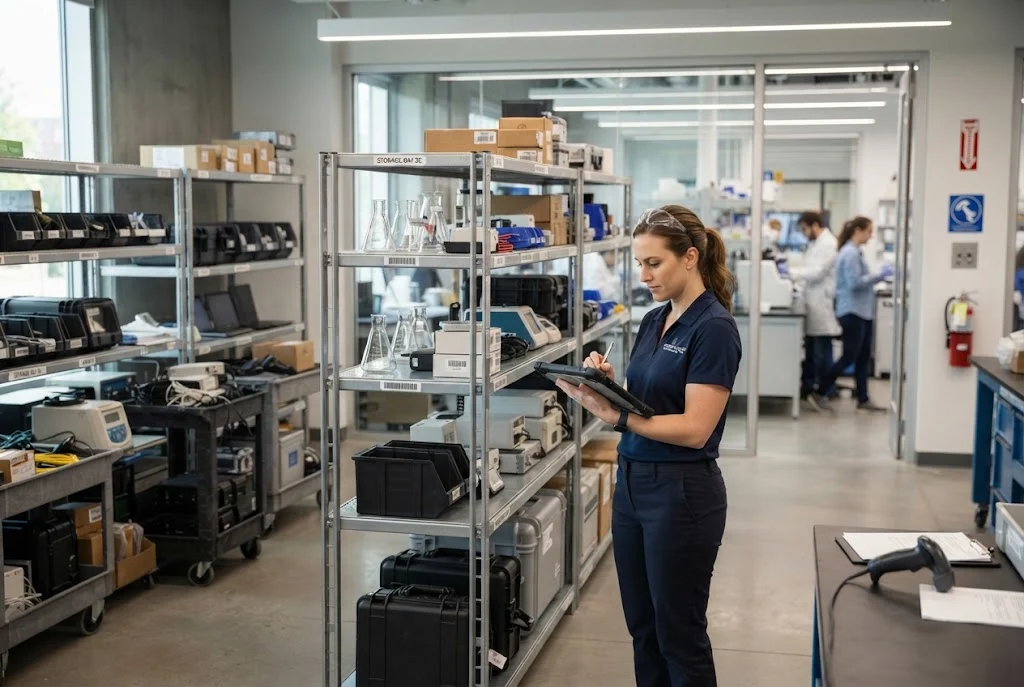
For universities operating across multiple departments or campuses, informal spreadsheets and disconnected records can make resource planning difficult. A structured inventory system creates better visibility, supports responsible purchasing, reduces unnecessary duplication, and helps faculty and staff access essential resources when they need them.
What Is Higher Education Inventory Management?
Higher education inventory management involves maintaining accurate records of resources held by academic departments, research units, administrative offices, facilities teams, libraries, laboratories, and other university operations.
The process can include purchasing, receiving, labeling, storing, issuing, transferring, maintaining, counting, reconciling, and eventually disposing of inventory or equipment according to institutional policies.
It is useful to distinguish inventory from fixed or capital assets because universities may apply different accounting, tracking, and verification requirements to different categories of property. The exact rules vary by institution, so inventory procedures should always align with the university’s finance, procurement, property-management, and compliance policies.
Why Inventory Management Matters in Higher Education
Universities manage resources in environments where availability, accountability, and cost control all matter. A missing laboratory item can delay research. An outdated equipment record can make it difficult to locate an asset. Excess supplies can consume storage space and tie up funds, while insufficient stock can interrupt teaching or administrative work.
Effective inventory management helps institutions establish a reliable record of resources and make better decisions about purchasing, allocation, maintenance, storage, and replacement.
Better Resource Visibility
A centralized inventory record can show what resources exist, their current location, responsible department, condition, and availability. This visibility is particularly valuable when equipment or supplies are shared between departments.
More Responsible Purchasing
Before purchasing additional supplies or equipment, departments can review existing inventory and determine whether an appropriate resource is already available elsewhere on campus. This can reduce unnecessary duplication and support more deliberate procurement decisions.
Stronger Accountability
Clear records establish responsibility for inventory and equipment. Universities can document transfers, assignments, movements, and other changes instead of relying on informal communication or outdated lists.
Improved Operational Continuity
Teaching, research, facilities management, and student services all depend on resources being available at the appropriate time. Accurate inventory records make it easier to identify shortages, locate items, and plan replenishment or replacement.
Key Components of Higher Education Inventory Management
1. Centralized Inventory Records
A university should maintain a dependable record of the resources covered by its inventory policies. Useful fields can include item name, identification number, department, location, quantity, responsible person, condition, acquisition information, and relevant status information.
The level of detail should reflect the type and value of the resource. High-value equipment generally requires more detailed accountability than routine consumable supplies.
2. Asset Identification and Labeling
Identification systems make it easier to connect physical items with their digital records. Depending on the institution and the type of resource, this may involve barcodes, serial numbers, RFID tags, asset labels, or other identification methods.
Consistent identification becomes especially important when resources move between laboratories, classrooms, offices, storage areas, and campuses.
3. Location Tracking
Location information should be updated when inventory moves. An accurate location record reduces the time required to find equipment and makes physical verification more efficient.
Universities should also define who is responsible for updating location information and how transfers are documented. Leaving changes until the next annual or periodic inventory can create unnecessary reconciliation problems.
4. Physical Inventory Verification
Digital records should periodically be compared with what actually exists. Physical verification can confirm the item’s existence, location, condition, and accountability.
The appropriate frequency depends on institutional policy, asset type, risk, funding requirements, and other circumstances. Some universities use annual counts for particular inventory categories, while others use periodic or biennial verification for certain equipment.
5. Reconciliation and Exception Management
When the physical count does not match the system record, the difference should be investigated rather than simply ignored. Common exceptions can include missing items, incorrect locations, duplicate records, unrecorded transfers, damaged resources, or outdated information.
Resolving exceptions promptly helps maintain the reliability of the inventory system and reduces the accumulation of unresolved discrepancies.
Technology in Higher Education Inventory Management
Technology can make inventory management more consistent and scalable, particularly for institutions with large quantities of equipment and supplies.
Inventory platforms can centralize records and provide controlled access to departments. Barcode and RFID systems can simplify identification and physical verification. Cloud-based systems can make information available to authorized users across multiple locations, while reporting tools can help administrators identify patterns in resource use.
Technology should support the institution’s inventory process rather than replace it. A sophisticated platform will not solve problems caused by unclear responsibilities, inconsistent data entry, weak transfer procedures, or a lack of physical verification.
Inventory Management for Laboratories and Research Departments
Research environments can have particularly complex inventory requirements. Laboratories may manage instruments, consumables, technical supplies, specialized equipment, and materials with different storage or handling requirements.
Research departments should establish clear procedures for recording resources, assigning responsibility, documenting movements, and identifying items that require maintenance or special controls.
For laboratory environments, inventory management should also work alongside applicable safety, environmental, research, and institutional requirements. The inventory record should provide enough information to support responsible handling without becoming disconnected from the broader laboratory management process.
Managing Classroom and Instructional Resources
Inventory management also supports everyday teaching. Classrooms, media rooms, studios, workshops, and instructional laboratories may depend on computers, projectors, furniture, technical equipment, teaching materials, and specialized tools.
A reliable record helps departments understand which resources are available and which require repair, replacement, or reassignment. Better resource visibility can also support the broader goal of improving learning experiences in the classroom.
Controlling Inventory Costs
Inventory represents resources that have already required institutional spending and may also create ongoing storage, maintenance, security, and administrative costs.
Universities can improve cost control by examining purchasing patterns, identifying slow-moving resources, reviewing duplicate stock, and considering whether existing resources can be shared or reassigned before additional purchases are made.
Inventory levels should not simply be pushed as low as possible. The objective is to maintain an appropriate level that supports academic and operational needs without creating unnecessary excess.
Identify Slow-Moving Items
Items that remain unused for long periods may deserve additional review. Depending on institutional policy, departments may be able to transfer, return, repurpose, or otherwise manage these resources rather than continuing to purchase more of the same type.
Coordinate Procurement With Inventory Data
Procurement teams can make better decisions when purchasing information is connected with current inventory records. Before placing a new order, departments can check existing quantities, recent consumption, outstanding orders, and planned requirements.
Consider the Full Cost
The purchase price is not the only cost associated with inventory. Storage, maintenance, security, deterioration, administrative effort, and eventual disposal can also affect the total cost of holding resources.
Inventory Security and Accountability
Universities need controls appropriate to the resources they hold. High-value equipment, sensitive technology, specialized research resources, and other valuable property may require stronger safeguards than ordinary supplies.
Role-based access can help limit who may modify inventory records. Audit trails can provide a history of changes, while documented transfer procedures can help maintain accountability when equipment moves between people or departments.
Physical safeguards are equally important. Appropriate storage, access controls, identification labels, and responsible-person records can reduce the risk of loss, theft, or unauthorized use.
How to Improve Higher Education Inventory Management
Institutions do not necessarily need to redesign their entire inventory operation at once. A phased approach can make improvement more manageable.
- Audit current records: Identify missing information, duplicate records, outdated locations, and unresolved discrepancies.
- Define inventory categories: Separate consumables, equipment, capital assets, research resources, and other categories according to institutional policy.
- Assign responsibility: Establish who records purchases, updates locations, approves transfers, performs counts, and resolves discrepancies.
- Standardize identification: Use consistent naming, identification numbers, labels, and location terminology.
- Introduce appropriate technology: Select inventory software or tracking tools that match the institution’s scale and requirements.
- Schedule verification: Establish physical-count or verification procedures based on institutional policy and risk.
- Review inventory data: Use reports to identify excess stock, recurring shortages, underused resources, and maintenance needs.
- Improve staff training: Make sure employees understand how and when inventory records must be updated.
Connecting Inventory Management With Academic Operations
Inventory management should not operate as an isolated administrative task. Its effectiveness increases when it connects with procurement, finance, facilities, information technology, research administration, and academic departments.
For example, technology resources may require coordination between academic departments and IT teams. Classroom equipment may involve facilities and instructional staff. Research equipment may require cooperation between laboratories, finance teams, and property-management personnel.
This cross-functional approach creates a more complete picture of institutional resources and can help departments avoid making decisions based only on incomplete local information.
Strong resource management also complements efforts to create effective learning environments and support the practical needs of students and educators.
Common Inventory Management Challenges
Disconnected Records
When departments maintain separate spreadsheets or databases, information can become inconsistent. Establishing a clear system of record can reduce confusion.
Outdated Locations
Equipment may move without the corresponding record being updated. Requiring transfers to be documented as they happen helps prevent this problem.
Unclear Ownership
If no individual or department is responsible for an inventory record, discrepancies can remain unresolved. Defined responsibilities improve accountability.
Infrequent Reviews
Waiting until a formal inventory period to discover every discrepancy can create unnecessary work. Regular record maintenance makes larger verification exercises easier.
Overreliance on Technology
Software can improve visibility, but accurate inventory still depends on disciplined processes and reliable human input. Technology should be combined with clear procedures and physical verification.
Frequently Asked Questions
What is inventory management in higher education?
It is the organized process of recording, tracking, storing, maintaining, verifying, and controlling university resources such as supplies, equipment, and other inventory items.
Why is inventory management important for universities?
It helps universities maintain accurate records, improve resource visibility, support responsible purchasing, protect valuable resources, and keep academic and operational activities supplied.
What technology can universities use for inventory tracking?
Depending on institutional needs, universities can use inventory databases, barcode systems, RFID identification, cloud platforms, mobile scanning tools, and reporting systems.
How often should university inventory be counted?
There is no single schedule that applies to every institution or inventory category. Universities should follow their own policies and consider asset type, value, risk, funding requirements, and applicable regulations.
How can inventory management reduce university costs?
Accurate inventory information can help identify duplicate purchases, excess stock, underused resources, and avoidable replacement costs. It can also improve planning and resource allocation.
Should all university assets be managed the same way?
No. Different resources may have different accounting, security, maintenance, verification, and disposal requirements. Inventory procedures should reflect institutional policies and the characteristics of each resource category.
Conclusion
Higher education inventory management is more than keeping a list of supplies and equipment. It provides the information universities need to understand their resources, maintain accountability, plan purchases, support academic operations, and manage institutional costs responsibly.
The strongest approach combines accurate records, clear ownership, appropriate technology, physical verification, responsible procurement, and regular review. When these elements work together, universities can make better use of existing resources while creating a more reliable foundation for teaching, research, administration, and long-term institutional planning.