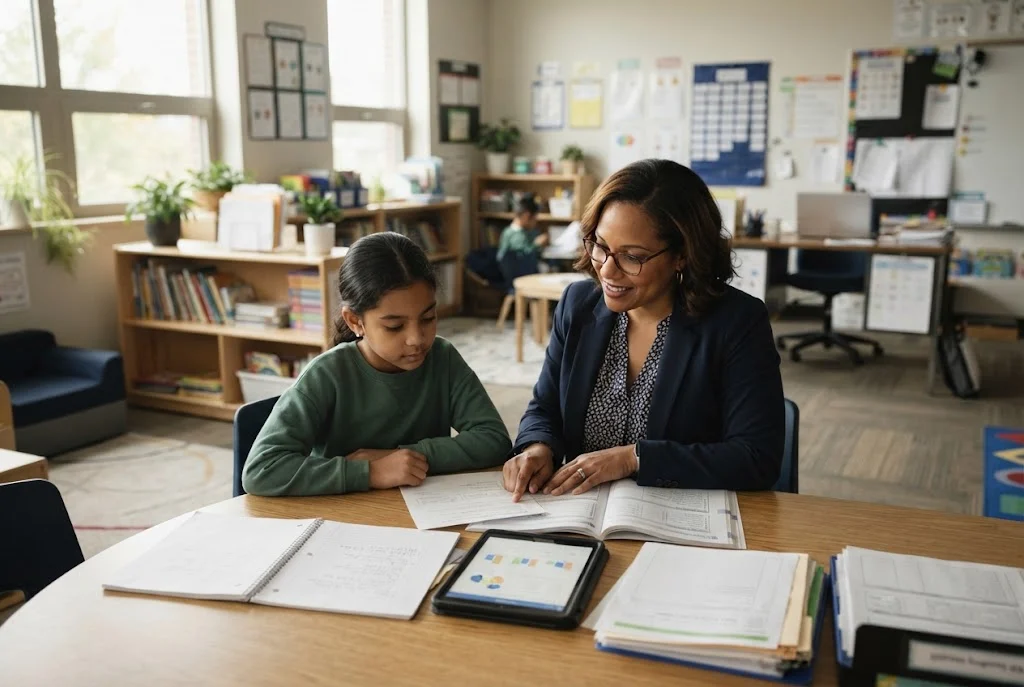
Although the exact job title, certification requirements, and responsibilities can vary by state and school system, the core purpose is consistent: use reliable information to better understand a student’s educational needs and help the school team determine appropriate support.
Federal special education requirements emphasize that eligibility decisions should draw on multiple sources of information rather than relying on a single test or measurement. IDEA also requires evaluation procedures to gather relevant academic, developmental, and functional information.
What Is an Education Diagnostician?
An education diagnostician is a specialized education professional who helps evaluate students who may have disabilities or other educational needs. Their work can involve reviewing records, gathering assessment information, interpreting results, participating in evaluation teams, and helping translate findings into educational recommendations.
The role is particularly relevant in special education because identifying a student’s needs requires more than simply observing whether the student is struggling. A school team needs to understand the nature of the difficulty, the student’s strengths, the educational impact, and what additional support may be appropriate.
In the United States, the specific scope of an education diagnostician’s role depends on state regulations and local school-system structures. For example, Texas maintains a specific educational diagnostician certification framework that includes identification, assessment, eligibility procedures, and educational programming.
Why Educational Diagnosis Matters
Students do not all learn in the same way. A student who is struggling with reading may have very different needs from a student experiencing difficulties with attention, communication, behavior, motor skills, or another area of development.
Educational evaluation helps schools move from a general observation such as “the student is struggling” toward a more detailed understanding of what is happening and what information is needed to support the learner.
Under IDEA, evaluation procedures are intended to gather academic, developmental, and functional information that can help determine whether a student has a disability and inform the content of the student’s individualized education program.
This makes assessment an important part of educational decision-making rather than simply an administrative requirement.
Core Responsibilities of an Education Diagnostician
The day-to-day responsibilities can differ between districts and states, but several areas commonly form the foundation of the role.
1. Reviewing Student Information
Before an evaluation begins, professionals may review existing educational records, classroom information, previous evaluations, teacher observations, parent input, and other relevant information.
Looking at existing information helps the evaluation team understand the student’s educational history and identify areas where additional assessment may be necessary.
2. Conducting or Supporting Assessments
Assessment is one of the most visible parts of the diagnostician’s work. Depending on the professional’s qualifications and the requirements of the school system, assessments may examine academic performance, cognitive processes, behavior, communication, development, or other areas relevant to the suspected educational need.
IDEA requires public agencies to use a variety of assessment tools and strategies rather than using one test as the sole criterion for determining disability or an appropriate educational program.
3. Interpreting Assessment Results
Collecting scores is only one part of an evaluation. The results must be interpreted alongside other available information.
Federal regulations specifically require evaluation teams to consider information from multiple sources, including aptitude and achievement tests, parent input, teacher recommendations, and information about areas such as physical condition, social or cultural background, and adaptive behavior.
4. Participating in Eligibility Decisions
An education diagnostician may contribute professional assessment expertise to an evaluation team, but eligibility decisions are not necessarily the decision of one individual.
Under IDEA, determining whether a child qualifies as a child with a disability and identifying educational needs involves a team of qualified professionals and the child’s parent.
5. Helping Develop Educational Recommendations
Evaluation findings should have practical educational value. The information gathered can help the team understand the student’s present needs and determine whether changes to special education or related services may be appropriate.
For students who are found eligible for special education and related services, IDEA provides for development of an individualized education program, commonly known as an IEP.
How the Evaluation Process Works
The evaluation process is more comprehensive than simply giving a student a standardized test. It involves gathering information, selecting appropriate assessment methods, interpreting findings, and considering the student’s educational context.
Step 1: Recognizing a Possible Educational Need
A concern may arise from classroom performance, teacher observations, parent concerns, developmental information, or other evidence suggesting that a student may need additional evaluation.
IDEA allows either a parent or a state or local educational agency to initiate a request for an initial evaluation to determine whether a child may have a disability.
Step 2: Obtaining Appropriate Consent
For an initial evaluation under IDEA, the public agency must obtain informed parental consent before conducting the evaluation. Consent for an evaluation is not the same as consent for placement in special education services.
Step 3: Gathering Multiple Sources of Information
The evaluation team considers information from different sources rather than relying on one test result. This can include academic records, classroom observations, parent information, teacher recommendations, assessments, and other relevant evidence.
This approach is important because a student’s performance can be affected by many factors. A comprehensive evaluation helps reduce the risk of drawing conclusions from incomplete information.
Step 4: Conducting Assessments
Assessment procedures should be appropriate for the questions being investigated. IDEA requires assessments to be valid and reliable for their intended purposes and administered by trained and knowledgeable personnel.
Assessments should also consider the student’s suspected areas of disability. Federal regulations call for evaluation procedures that are sufficiently comprehensive to identify the child’s special education and related service needs.
Step 5: Interpreting the Findings
Assessment results become meaningful when they are considered alongside the student’s educational history and other evidence. The team looks at patterns, strengths, weaknesses, functional needs, and educational performance.
Step 6: Making an Educational Determination
The team considers whether the student meets applicable disability criteria and whether the student needs special education and related services. The decision must follow applicable federal and state requirements.
What Does an Education Diagnostician Assess?
The areas considered during an evaluation depend on the reason for referral and the suspected disability. A comprehensive evaluation may consider several dimensions of a student’s functioning.
- Academic performance: Reading, writing, mathematics, and other educational skills.
- Cognitive factors: Relevant aspects of thinking, reasoning, memory, or information processing.
- Communication: Language and communication abilities when relevant to the evaluation.
- Behavior: Behavioral patterns that may affect educational performance.
- Development: Developmental information relevant to the student’s educational needs.
- Functional performance: Skills and abilities that influence participation in the educational environment.
- Social and emotional factors: Relevant information that may help explain educational performance.
- Motor or sensory factors: Areas such as vision, hearing, or motor abilities when relevant to the suspected disability.
IDEA specifically requires assessments to address all areas related to the suspected disability and describes areas that may include health, vision, hearing, social and emotional status, general intelligence, academic performance, communication, and motor abilities.
The Importance of Multiple Sources of Evidence
One of the most important principles in educational assessment is that a single score should not tell the entire story.
A student may perform differently depending on the environment, task, instructional approach, communication method, or level of support available. For this reason, evaluation teams need information that provides a broader picture of the learner.
IDEA states that a single measure cannot be used as the sole criterion for determining whether a child has a disability or for determining an appropriate educational program.
This principle also reinforces the importance of collaboration among educators, families, and qualified professionals.
Working With Teachers and Families
An education diagnostician does not work in isolation. Teachers see students in instructional settings, parents can provide important developmental and behavioral context, and other specialists may contribute information from their areas of expertise.
IDEA requires evaluation teams to consider information from parents and teachers alongside assessment data.
Effective collaboration therefore involves listening as well as testing. A professional assessment should help the team understand the learner rather than reduce the learner to a collection of numbers.
This collaborative approach fits naturally with broader discussions about creating effective learning environments. HorizonNote’s guide to transforming a special education classroom explores how classroom design, instructional support, routines, and accessibility can influence the learning experience.
Education Diagnostician vs. School Psychologist
Education diagnosticians and school psychologists can both contribute to special education evaluation, but their exact responsibilities depend on state law, credentials, and district organization.
School psychologists may have specialized responsibilities involving psychological assessment, behavioral evaluation, counseling, consultation, and other services. Education diagnosticians may focus more heavily on educational assessment and special education eligibility processes in jurisdictions where that role is formally recognized.
The distinction should not be treated as universal because states define professional credentials and scopes of practice differently.
Federal IDEA regulations also recognize multiple qualified professionals within evaluation processes. For certain specific learning disability determinations, the required team includes the child’s regular teacher and at least one person qualified to conduct individual diagnostic examinations, such as a school psychologist, speech-language pathologist, or remedial reading teacher.
Skills Needed for an Education Diagnostician
The role requires more than the ability to administer assessments. Professionals need a combination of technical, analytical, communication, and interpersonal skills.
Assessment Knowledge
Professionals need to understand assessment tools, appropriate administration procedures, limitations, and how results should be interpreted.
Data Interpretation
Evaluation involves turning information into meaningful educational conclusions. Strong analytical skills help professionals recognize patterns without treating test scores as isolated facts.
Communication
Assessment reports can contain complex terminology. A diagnostician needs to communicate findings clearly to educators and families so the information can contribute to practical decision-making.
Collaboration
Special education decisions involve multiple people. Collaboration skills are therefore essential for working with teachers, parents, administrators, and other specialists.
Attention to Detail
Educational evaluations require careful documentation. Small details can affect how assessment information is interpreted and how recommendations are developed.
Understanding of Special Education Requirements
Professionals working in this area need a strong understanding of the applicable federal, state, and local requirements governing evaluation and eligibility.
How an Education Diagnostician Supports Individualized Learning
The purpose of assessment should ultimately connect back to the learner. Once educational needs are better understood, the information can contribute to more individualized instruction and support.
Individualization does not mean creating a completely separate educational system for every student. It means using reliable information to understand what a learner needs to participate, make progress, and access appropriate educational opportunities.
This can involve identifying instructional barriers, clarifying strengths, recommending appropriate supports, and helping educators understand which areas require additional attention.
For a broader look at professionals who help identify and address learner needs, readers can explore HorizonNote’s related article on education diagnostics and learner potential.
Education Diagnostician Career Preparation
People interested in becoming an education diagnostician should begin by researching the requirements in the state where they intend to work. There is no single national career pathway that can simply be applied to every state.
Depending on jurisdiction, preparation may involve an education degree, teaching experience, graduate-level study, specialized coursework, examinations, or a state-issued credential. Requirements can change, so candidates should verify current information with their state education agency.
Texas, for example, maintains a dedicated Educational Diagnostician certification framework that includes competencies related to identification, assessment, eligibility, instructional planning, and educational decision-making.
Students considering education careers can also explore related pathways. For example, HorizonNote covers education requirements for skilled careers, illustrating how career preparation can differ substantially between professions.
Challenges in Educational Assessment
Educational assessment can be complex because students are influenced by many factors beyond academic ability. Language, culture, instruction, environment, developmental differences, and access to appropriate educational opportunities can all be relevant when interpreting information.
IDEA requires evaluation materials to be selected and administered in ways intended to avoid discriminatory assessment practices and, when feasible, in the language and form most likely to produce accurate information about what the child knows and can do.
Professionals must therefore pay attention not only to what an assessment measures, but also to whether the assessment process provides an appropriate representation of the student’s abilities.
Why the Education Diagnostician Role Matters
Students can struggle for many different reasons, and educational support is more effective when decisions are based on a careful understanding of those needs.
The education diagnostician’s contribution is valuable because assessment can provide structured information that helps educators and families understand a student’s educational profile. The goal is not simply to identify a label. The larger purpose is to understand educational needs and support appropriate decisions.
Federal regulations require evaluations to be sufficiently comprehensive to identify all of a child’s special education and related service needs, whether or not those needs are commonly associated with the disability category under consideration.
Frequently Asked Questions About Education Diagnosticians
What does an education diagnostician do?
An education diagnostician helps evaluate students who may have disabilities or other educational needs. Depending on the state and school system, responsibilities can include reviewing records, conducting or supporting assessments, interpreting results, preparing documentation, collaborating with educators and families, and contributing to eligibility and educational planning.
Does an education diagnostician diagnose medical conditions?
The role is primarily educational rather than medical. Educational evaluation focuses on understanding a student’s academic, developmental, functional, behavioral, or other educational needs within the applicable special education framework.
Can one test determine whether a student qualifies for special education?
No. IDEA states that a single measure cannot be used as the sole criterion for determining whether a child has a disability or for determining an appropriate educational program.
Do education diagnostician requirements differ by state?
Yes. Certification titles, educational requirements, examinations, experience requirements, and permitted responsibilities can vary by state. Anyone pursuing this career should verify requirements with the relevant state education authority.
How does an education diagnostician support students?
By helping schools gather and interpret relevant information about a student’s educational needs. The resulting information can contribute to individualized educational planning, appropriate services, and better-informed decisions.
Conclusion
An education diagnostician can serve an important role in the special education evaluation process by bringing assessment knowledge, data interpretation, documentation, and collaboration together around the needs of individual learners.
The strongest approach to educational assessment is not to reduce a student to one test score. It is to consider multiple sources of evidence, understand the student’s educational context, listen to families and educators, and use reliable information to support meaningful educational decisions.
As learners’ needs become better understood, schools can make more informed choices about instruction, services, accommodations, and other supports. Explore more education resources and learning-focused guides on HorizonNote to continue building a broader understanding of education, special education, and professional development.