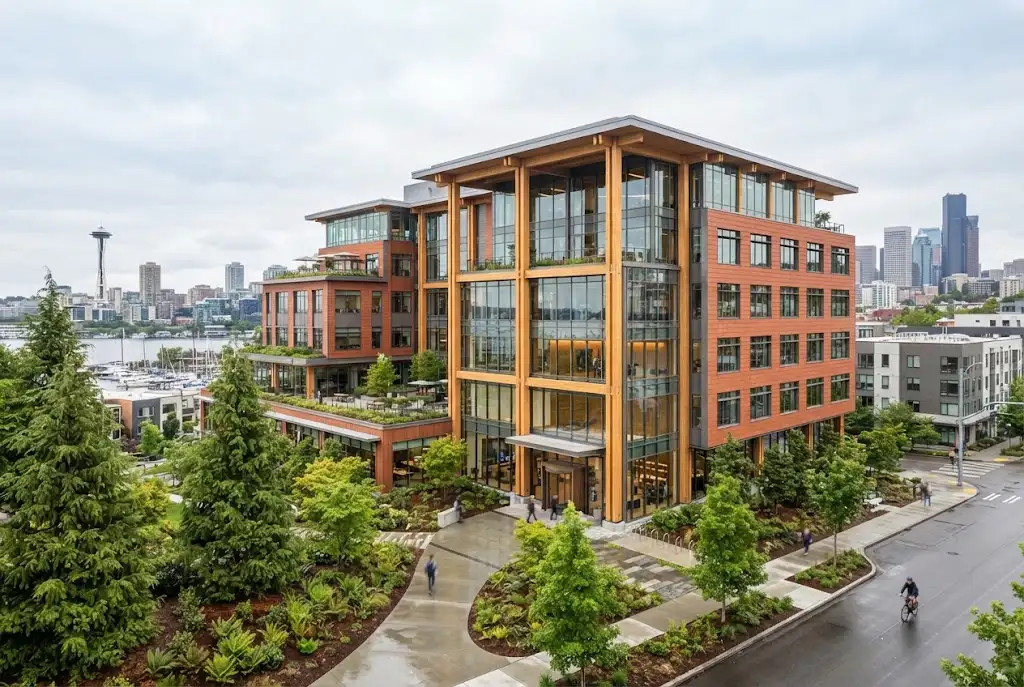
For investors, business owners, and commercial tenants, understanding SCGA’s approach requires looking beyond the phrase “commercial real estate.” The company’s portfolio spans several property types, while its work emphasizes development, design, sustainability, and long-term property management.
This guide explains what SCGA does, the types of commercial properties associated with the company, what investors should evaluate, and how to approach commercial real estate opportunities in the Seattle market.
What Is SCGA Commercial Real Estate?
Stephen C. Grey & Associates is a Seattle-based real estate company founded in 1998. The company describes itself as a Northwest real estate development group with a focus on sustainable, high-quality projects, design, and innovation.
Its work is broader than simply buying and selling commercial buildings. SCGA’s services include real estate development and property management, while its portfolio includes several different commercial property categories.
This broader approach matters because commercial real estate performance depends on much more than the building itself. Location, tenant demand, property management, operating costs, design, redevelopment potential, and long-term market conditions can all influence an asset’s performance.
What Types of Commercial Properties Does SCGA Work With?
SCGA’s official property portfolio identifies several categories of real estate. Each category has different operating characteristics and investment considerations.
Commercial Office
Office properties are designed around business occupancy and can range from traditional office buildings to newer workplaces with modern amenities and sustainability features.
For investors, office properties require careful analysis of tenant demand, lease terms, vacancy, operating expenses, building condition, and the changing needs of businesses.
Commercial Retail
Retail properties depend heavily on location, visibility, accessibility, surrounding businesses, tenant mix, and consumer activity.
A retail property with strong traffic and complementary neighboring businesses may have a very different risk profile from a property that depends on a single tenant or has limited visibility.
Warehouse and Flex Properties
Warehouse and flex space can serve businesses requiring storage, distribution, light industrial functions, offices, or combinations of uses.
Important considerations can include loading access, ceiling height, parking, transportation connections, zoning, building condition, and the suitability of the space for prospective tenants.
Multifamily Real Estate
Multifamily properties provide residential units within a commercial investment structure. Their performance can be influenced by rental demand, unit mix, operating costs, property management, maintenance requirements, and local housing conditions.
Marina Properties
Marina assets are a specialized category of real estate because they combine property management with waterfront infrastructure and recreational use.
Investors evaluating marina properties need to consider factors that do not apply to a conventional office or retail building, including waterfront conditions, slips, maintenance, environmental considerations, and applicable regulations.
Historic Properties
Historic buildings can offer distinctive architectural character and strong identity, but they may also involve additional maintenance, preservation, permitting, and renovation considerations.
Why Seattle Matters to SCGA’s Real Estate Strategy
SCGA’s identity is closely connected to the Pacific Northwest and Seattle. The company’s portfolio includes projects in areas such as Fremont and other Seattle neighborhoods.
Seattle’s commercial real estate environment contains a mixture of established office districts, industrial areas, neighborhood retail, multifamily properties, and redevelopment opportunities. That diversity creates opportunities for investors but also means that commercial property should be evaluated at the neighborhood and asset level.
A property located near major employment centers may have different tenant considerations from a neighborhood retail property or a warehouse serving industrial users.
For readers researching different property markets, HorizonNote’s guide to Huntington Beach real estate offers a useful residential comparison, while SCGA’s portfolio represents a much stronger commercial and development-oriented perspective.
SCGA’s Emphasis on Sustainable Development
Sustainability is an important part of SCGA’s stated development philosophy. The company describes its projects in terms of sustainable, high-quality development, design, and innovation.
Its Watershed project in Seattle is one example of that approach. SCGA’s project materials describe the building as pursuing high-level green building objectives while addressing tenant needs.
Northlake Commons is another project associated with SCGA and has received attention for its sustainable design and mass-timber construction approach.
For commercial investors, sustainable design can be relevant beyond environmental considerations. Building efficiency, operating costs, tenant expectations, building quality, and long-term adaptability can all influence how a property performs over time.
What Makes a Commercial Real Estate Opportunity Attractive?
There is no single formula for identifying a strong commercial property. Investors should examine the underlying economics and physical characteristics of each asset.
Location
Location affects tenant demand, accessibility, visibility, transportation, surrounding development, and potential future uses.
Tenant Quality
For an income-producing property, the financial strength and lease structure of tenants can be as important as the physical building.
Lease Structure
Investors should understand lease duration, renewal options, rent increases, operating-expense responsibilities, tenant improvement obligations, and other contractual provisions.
Operating Costs
Insurance, maintenance, utilities, property management, taxes, repairs, and capital expenditures can significantly affect net operating income.
Future Capital Requirements
A property may look attractive based on current income while requiring substantial future investment in roofs, mechanical systems, interiors, accessibility improvements, or other building components.
SCGA Commercial Real Estate and Property Management
Property management is particularly important in commercial real estate because a building’s financial performance depends partly on how effectively it is operated.
Management responsibilities can include tenant communication, maintenance coordination, building operations, leasing support, vendor relationships, budgeting, and long-term asset planning.
SCGA’s team includes property-management professionals, and the company describes itself as a full-service real estate company. Its principal, Mark Grey, has professional experience in both multifamily and commercial projects and holds CCIM and CPM designations.
This combination of development and property-management experience can be relevant when evaluating how a commercial asset is operated after development or acquisition.
How Investors Should Analyze an SCGA-Related Property
If you are evaluating a specific property associated with SCGA, do not rely solely on the developer or property name. Analyze the individual asset.
- Identify the property type: Determine whether it is office, retail, warehouse/flex, multifamily, marina, or another asset class.
- Study the location: Examine surrounding businesses, transportation, development activity, and tenant demand.
- Review occupancy: Understand current occupancy, vacancies, and tenant concentration.
- Analyze leases: Review lease duration, rent structure, renewal options, and responsibilities for operating expenses.
- Review financials: Examine income, expenses, net operating income, capital expenditures, and other relevant financial information.
- Inspect the building: Evaluate major systems, maintenance requirements, and deferred capital expenditures.
- Check zoning and permitted uses: Confirm that the property’s existing and planned uses comply with applicable requirements.
- Consider exit options: Think about the likely future buyer or tenant market before committing capital.
Commercial Real Estate vs. Residential Real Estate
Commercial and residential real estate should not be evaluated using exactly the same criteria.
| Factor | Commercial Real Estate | Residential Real Estate |
|---|---|---|
| Primary purpose | Business, investment, retail, office, industrial, or other commercial use | Personal residence or residential investment |
| Income analysis | Often closely tied to leases, occupancy, and operating expenses | Typically based on rental income or personal-use value |
| Tenant relationship | Often contractual and business-oriented | Residential tenancy or owner occupancy |
| Due diligence | May include leases, environmental issues, zoning, financials, and building systems | Often focuses on condition, title, financing, neighborhood, and property-specific issues |
| Management | Can involve specialized commercial property management | Generally simpler, depending on property and ownership structure |
For readers interested in residential markets, HorizonNote also covers Winnett, Montana real estate, where the investment considerations are very different because the market centers more heavily on homes, land, acreage, and rural property.
What Investors Should Know About Seattle Commercial Property
Seattle commercial real estate should be evaluated property by property rather than through broad assumptions about the entire city.
Different submarkets can have different tenant profiles, vacancy conditions, development pipelines, transportation characteristics, and property values.
Investors should therefore investigate the immediate neighborhood as well as the broader Seattle market. A commercial building’s competitive position can depend heavily on what is happening within a relatively small geographic area.
Development Potential and Adaptive Reuse
Development potential can be an important consideration when evaluating commercial property. An existing building may have opportunities for renovation, repositioning, expansion, or changes in use, subject to zoning, permitting, financing, and physical constraints.
Adaptive reuse can also create opportunities when an older property has characteristics that remain valuable despite changes in how businesses use commercial space.
However, potential redevelopment should never be treated as guaranteed. Investors should confirm zoning, permitting requirements, building constraints, costs, and market demand before assigning value to a future development scenario.
How SCGA Compares With Other Real Estate Opportunities
Commercial property is only one part of the broader real estate investment landscape.
For example, HorizonNote’s Kensington real estate Mallorca guide focuses on an international residential market where lifestyle, coastal location, property type, and buyer objectives play a major role.
Likewise, Placerville, Idaho real estate represents another type of property market with different geographic and investment characteristics.
These comparisons reinforce an important principle: the best real estate opportunity depends on the asset class, location, investment objective, financing structure, and risk tolerance.
Questions to Ask Before Investing in Commercial Property
Before committing capital to a commercial real estate investment, investors should ask detailed questions about both the property and the financial structure.
- What is the property’s current occupancy rate?
- Who are the major tenants?
- When do the largest leases expire?
- Are rents below, near, or above comparable market levels?
- What operating expenses does the owner pay?
- Are significant capital expenditures expected?
- What zoning applies to the property?
- Are there environmental or building-condition concerns?
- What financing assumptions are being used?
- What would make the property attractive to a future buyer?
Frequently Asked Questions
What does SCGA stand for in commercial real estate?
In the context of the Seattle commercial real estate company discussed in this article, SCGA refers to Stephen C. Grey & Associates.
Where is SCGA based?
SCGA is based in Seattle, Washington, with its office listed at North Northlake Way.
What types of properties does SCGA have?
SCGA’s portfolio includes commercial office, commercial retail, warehouse and flex properties, multifamily properties, marinas, and historic properties.
Does SCGA only develop commercial real estate?
No. Its portfolio includes several property categories, and the company describes itself as a full-service real estate company involved in development and property management.
Is SCGA commercial real estate a good investment?
No commercial property should be considered automatically profitable simply because of its developer or owner. Investors should evaluate the specific property’s location, tenants, leases, financial performance, condition, expenses, financing, and future marketability.
What should I look for in a commercial real estate investment?
Important factors include location, tenant quality, lease terms, occupancy, operating expenses, capital requirements, zoning, financing, and potential resale or repositioning opportunities.
Final Takeaway
SCGA commercial real estate represents a broad Seattle-focused portfolio rather than a single property type. Stephen C. Grey & Associates works across commercial office, retail, warehouse and flex, multifamily, marina, and historic properties while emphasizing development, design, sustainability, and property management.
For investors, the most useful takeaway is to evaluate the individual asset rather than relying on the SCGA name alone. Strong commercial real estate analysis requires careful attention to location, tenants, leases, operating costs, building condition, zoning, financing, and future demand.
Whether you are researching an SCGA property or comparing commercial opportunities with residential markets elsewhere, disciplined property-level due diligence remains the most important step before making an investment decision.