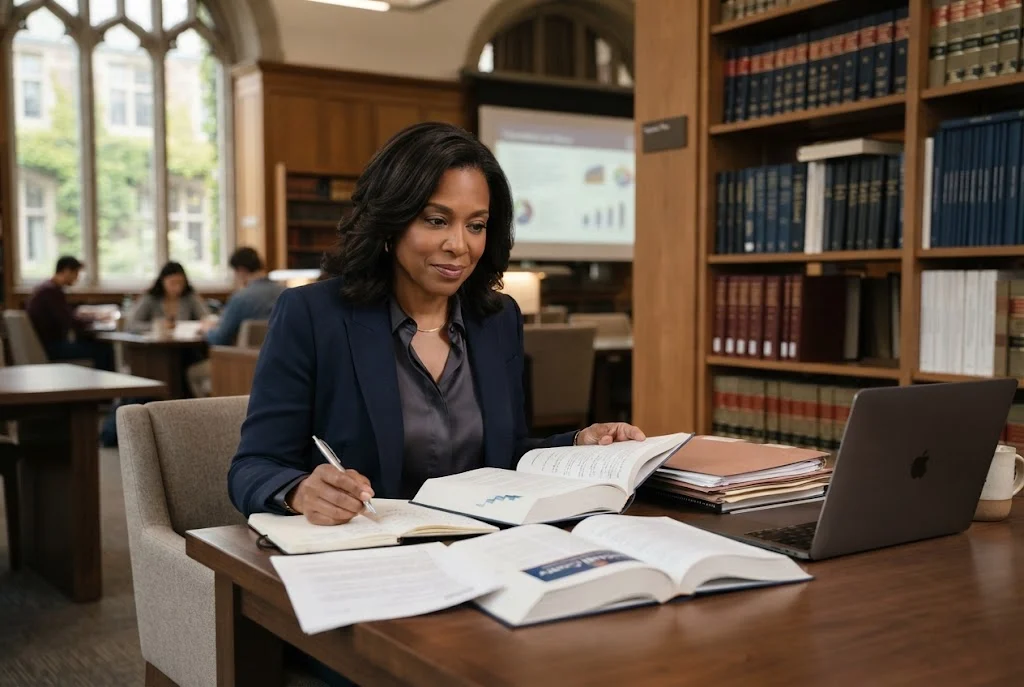
That makes her educational story more useful as a case study in continuous learning than as a description of a single degree or standalone training program. For readers exploring education, professional development, or career transitions, her path illustrates how formal education can become a foundation for skills that continue developing throughout a career.
Who Is Laura Coates?
Laura Coates is an American attorney, author, broadcaster, and educator. Her professional background includes legal practice, public service, teaching, television, radio, and writing. Her official biography identifies her as a CNN anchor and chief legal analyst, SiriusXM talk-show host, and author.
Her career also demonstrates how one educational foundation can support several professional directions. Instead of limiting her expertise to one setting, Coates has applied legal training to public communication, media analysis, teaching, and authorship.
For readers interested in broader educational pathways, HorizonNote’s Education category provides additional topics covering learning, professional preparation, and education-related careers.
Laura Coates Education: Her Academic Background
Laura Coates graduated from Princeton University’s School of Public and International Affairs in 2001. She later earned her Juris Doctor from the University of Minnesota Law School in 2005.
Those two stages of education helped establish a foundation combining public affairs, analytical thinking, research, communication, and legal reasoning. Her later career shows how those capabilities can transfer between professional environments.
Princeton University
Coates studied at Princeton University’s School of Public and International Affairs. Her undergraduate education provided a foundation in public affairs and analytical study before she moved into legal education.
A broad undergraduate education can be valuable because it develops transferable skills rather than focusing only on one job title. Research, writing, argumentation, information analysis, and understanding institutions can remain useful when a person’s career evolves.
University of Minnesota Law School
Coates earned her law degree from the University of Minnesota Law School in 2005. Her legal education became the basis for a career that included private practice and public service.
The University of Minnesota has also highlighted how her law-school experience prepared her for different professional directions. In a 2023 university profile, Coates described her time at the law school as important preparation for the different careers she later pursued.
This is an important point for students: the value of education is not always limited to the first profession someone enters. Strong analytical and communication skills can remain useful across multiple career stages.
From Education to a Legal Career
After completing her legal education, Coates practiced law in Minnesota and New York. Her work included areas such as intellectual property litigation, First Amendment issues, defamation, and media law.
She later entered public service with the U.S. Department of Justice. According to her official biography, she served as a trial attorney in the Civil Rights Division and worked on voting-rights enforcement. She also served as an Assistant United States Attorney for the District of Columbia.
This transition demonstrates how education can function as a platform rather than a final destination. Academic credentials provided the starting point, while professional experience added practical knowledge and specialization.
Laura Coates and Education as a Teaching Experience
Education was not limited to Coates’s role as a student. Her official biography states that she was formerly an adjunct professor at the George Washington University School of Law.
Teaching requires a different application of knowledge. A professional must move beyond understanding a subject and learn how to explain complex concepts clearly to other people. That skill is particularly important in law, journalism, public communication, and other fields where audiences may have different levels of subject knowledge.
For anyone considering an education-related career, the distinction between knowing something and teaching it effectively is worth remembering. Strong educators need subject knowledge, communication ability, organization, adaptability, and an understanding of how learners process information.
Readers interested in the broader role of education professionals can also explore HorizonNote’s guide to becoming an education diagnostician, a career centered on understanding learner needs and supporting educational outcomes.
What Laura Coates’ Career Shows About Lifelong Learning
The most useful lesson from the Laura Coates education story is not a particular course, credential, or educational program. It is the connection between formal education and continued professional development.
1. Education Can Create Transferable Skills
Research, writing, critical thinking, public speaking, and structured analysis can remain valuable even when someone changes roles. Coates’s movement from legal practice and public service into media and teaching illustrates this type of skill transfer.
2. Professional Experience Expands Academic Knowledge
A degree provides structured learning, but professional environments introduce different forms of knowledge. Real cases, deadlines, audiences, ethical considerations, and communication challenges can add dimensions that classroom learning cannot completely replicate.
3. Communication Is a Core Career Skill
People may understand complicated information but still struggle to explain it. Coates’s work across law, teaching, television, radio, and writing demonstrates the importance of communicating complex subjects to broader audiences.
4. Career Development Does Not Have to Be Linear
A career can develop through several connected stages rather than following one predictable job path. Education can provide a foundation while experience, interests, and new responsibilities shape later professional directions.
How Students Can Apply These Lessons
Students do not need to follow the same career path to benefit from the broader educational lessons associated with Coates’s background. Instead, they can focus on building skills that remain useful across industries.
- Develop strong writing skills: Clear writing is useful in academic work, law, business, journalism, technology, and many other fields.
- Practice analytical thinking: Learn to evaluate evidence, identify assumptions, and build logical conclusions.
- Improve public communication: Presenting ideas clearly can become a major advantage in school and professional environments.
- Seek practical experience: Internships, projects, research, volunteering, and supervised work can complement classroom learning.
- Keep learning after graduation: Professional development can help people adapt as industries, technologies, and responsibilities change.
Students interested in practical career preparation can also read about education requirements for welding careers to see how education and technical preparation can combine in a specialized profession.
Education, Technology, and Modern Learning
Modern education increasingly combines traditional instruction with digital resources, online research, collaborative tools, and technology-assisted learning. That makes information literacy especially important.
Students should learn not only how to find information but also how to evaluate whether a source is credible, understand the context of a claim, and distinguish evidence from opinion. These skills are valuable in academic research and professional communication alike.
Technology can also improve access to learning materials, but it does not replace the need for thoughtful instruction. Effective learning still depends on clear goals, relevant material, feedback, practice, and the ability to apply knowledge.
HorizonNote’s article on transforming learning experiences in the special education classroom explores another side of modern education: designing learning environments around the needs of individual students.
Why Practical Application Matters in Education
One recurring challenge in education is the gap between learning information and using it. Students may perform well on an exam but struggle to apply the same concepts in a real situation.
Practical learning can help close that gap. Projects, simulations, internships, presentations, case studies, research assignments, and supervised professional experiences allow learners to test what they know.
This principle applies across education levels. A university student may apply research skills to a project, while a technical student may practice procedures in a controlled environment. The specific activity changes, but the underlying goal is similar: turning knowledge into usable capability.
Institutions also need practical systems behind the learning experience. For example, higher education inventory management addresses the operational side of maintaining resources that students and educators depend on.
Laura Coates Education and the Value of Clear Communication
Communication is especially relevant to Coates’s career because her work has repeatedly involved explaining complicated subjects to different audiences.
For students, this suggests an important educational exercise: practice explaining a difficult concept in simple language. If you can describe an idea clearly without losing its essential meaning, you are developing a skill that can transfer into presentations, interviews, teaching, management, writing, and client communication.
Useful Communication Exercises for Students
- Summarize a complex article in three sentences.
- Explain a technical concept to someone with no background in the subject.
- Present both sides of an academic issue before forming a conclusion.
- Rewrite a long explanation into a concise professional email.
- Practice answering questions without relying on unnecessary jargon.
These exercises can make education more active and can help students build confidence alongside subject knowledge.
How Career Changers Can Use Education Strategically
Coates’s career also provides a useful example for people who are thinking about professional transitions. Career changes do not always require abandoning everything learned previously. Existing skills can often become the foundation for a new direction.
A career changer can begin by identifying three things: existing knowledge, transferable skills, and the capabilities required for the target field. Formal education can then be used to close specific gaps instead of restarting from zero.
For example, someone moving into a technical occupation may need a new credential, while someone moving into management may benefit from leadership training, project experience, or additional business education. The right educational path depends on the target profession and its requirements.
What Makes an Education Path Valuable?
When evaluating an educational opportunity, students should look beyond promotional language. A useful program or learning pathway should have clear objectives, appropriate instruction, credible resources, practical opportunities, and outcomes that can be evaluated.
Before enrolling, consider questions such as:
- What specific skills will I develop?
- Who provides the instruction?
- What credentials or qualifications are awarded?
- Are those credentials relevant to my intended career?
- Does the learning include practical application?
- What support is available to students?
- Can the cost and time commitment fit my circumstances?
This approach is more reliable than choosing an educational opportunity solely because it promises fast career results.
Laura Coates Education: A More Accurate Perspective
The phrase “Laura Coates education” is best understood as a reference to Laura Coates’s educational background and her broader relationship with teaching and learning. Her official biography documents her education at Princeton University and the University of Minnesota Law School and notes her former role as an adjunct professor at George Washington University Law School.
That distinction matters because there is not enough reliable information to treat the phrase as evidence of a standalone educational institution or a documented proprietary training program. The original version of this article made broad claims about curriculum structures, student outcomes, licensing, and career statistics that are not supported by the authoritative sources reviewed for this refresh.
A stronger educational article should separate documented facts from general lessons that readers can reasonably draw from a person’s career. In this case, the documented record supports discussing Coates’s academic preparation, legal education, teaching experience, and continuing professional development.
Building Your Own Educational Roadmap
Readers can turn these lessons into a practical education roadmap by working backward from a career goal.
- Define the target: Identify the profession, role, or academic field you want to enter.
- Research requirements: Determine whether the field requires a degree, license, certification, apprenticeship, or another credential.
- Identify skill gaps: Compare your current capabilities with the requirements of the target role.
- Choose the learning format: Consider college, graduate education, professional training, certification, self-directed learning, or supervised experience.
- Add practical experience: Look for opportunities to apply new knowledge through projects, internships, volunteering, or employment.
- Review progress: Reassess your skills regularly and adjust your learning plan as your career develops.
This approach makes education a strategic process rather than simply a collection of credentials.
Frequently Asked Questions About Laura Coates Education
Where did Laura Coates go to college?
Laura Coates graduated from Princeton University’s School of Public and International Affairs in 2001.
Where did Laura Coates study law?
She earned her Juris Doctor from the University of Minnesota Law School in 2005.
Has Laura Coates taught at a university?
Yes. Her official biography states that she was formerly an adjunct professor at the George Washington University School of Law.
What can students learn from Laura Coates’s educational path?
Her career illustrates the value of transferable skills, continued learning, professional experience, and clear communication. Her education provided a foundation that could be applied across legal, teaching, media, and writing roles.
Is Laura Coates Education a university or degree program?
The authoritative sources reviewed for this article document Laura Coates’s academic background and teaching experience, but they do not establish a standalone university or degree program called “Laura Coates Education.”
Conclusion
The story behind Laura Coates education is ultimately a story about how formal education can evolve into a broader professional skill set. Her academic path through Princeton University and the University of Minnesota Law School was followed by legal practice, public service, teaching, broadcasting, and authorship.
For students and professionals, the practical lesson is straightforward: education does not have to define a single career destination. Strong foundational skills can continue to create opportunities when combined with experience, communication, curiosity, and purposeful professional development.
Explore more education and career-focused resources on HorizonNote, including practical guides covering learning environments, education careers, and professional preparation.