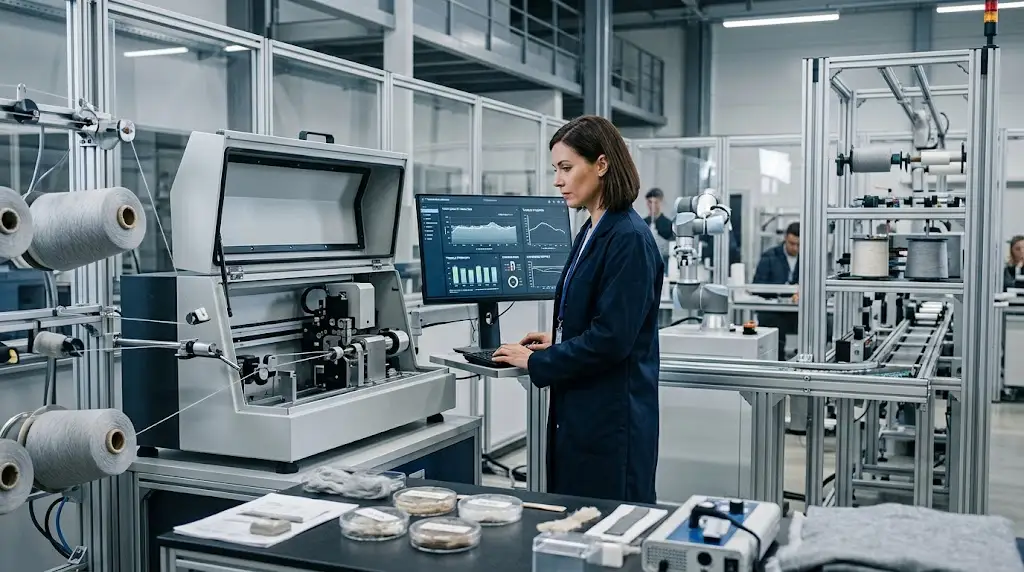
Uster Technologies AG: Revolutionizing Textile Quality Control and Innovation
Textile manufacturing depends on consistency. Small variations in fiber quality, yarn evenness, strength, contamination, or fabric formation can affect production efficiency, downstream processing, product appearance, and customer satisfaction. As textile production becomes more data-driven, manufacturers increasingly rely on accurate measurement and process-control technologies to identify problems before they become expensive defects.
Uster Technologies AG is a major technology provider in this field, offering testing, quality-management, process-control, inspection, laboratory, and service solutions across the textile value chain. Its current portfolio spans applications from raw-material purchasing and fiber preparation through yarn manufacturing, fabric production, and quality management.
The company’s approach goes beyond simply measuring finished materials. Uster combines instruments, software, benchmarks, laboratory services, and textile expertise to help manufacturers understand quality variation and respond to production issues. This makes textile quality control a more continuous process rather than a final inspection performed after production is complete.
What Is Uster Technologies AG?
Uster Technologies AG is a Switzerland-based textile technology company headquartered in Uster, Switzerland. Its current website describes Uster as a supplier of total quality solutions covering the journey from fiber to fabric, with a focus on precise measurement, quality management, and textile production efficiency.
The company has a long history in textile measurement. Uster’s own historical material traces the origins of its well-known Uster Tester technology to work on objective measurement of textile slivers, rovings, and yarn evenness, with the first instrumental method developed in the 1940s. The Uster Tester subsequently evolved as measurement capabilities, sensors, software, and connectivity advanced.
Today, the company’s portfolio includes laboratory systems, in-line process-control solutions, quality-management software, fiber-testing systems, yarn-testing equipment, fabric-inspection technologies, and related services.
Why Textile Quality Control Matters
Quality control is fundamental to textile manufacturing because raw materials and production processes naturally contain variation. The challenge for a mill is not simply to discover defects after they have occurred. It is to measure variation accurately, understand its cause, and respond quickly enough to prevent unnecessary waste.
For example, inconsistent fiber characteristics can influence yarn performance. Yarn irregularities can affect downstream processes such as weaving or knitting. Fabric-formation problems can create visible defects that are more costly to correct after production has progressed.
This is why modern textile quality management increasingly connects laboratory measurements with production-floor information. Uster’s Think Quality approach emphasizes specifying quality requirements, measuring performance, controlling processes, improving results, and sustaining consistency over time.
From Fiber to Fabric: A Connected Quality Approach
One of the most important characteristics of Uster’s technology portfolio is its coverage across multiple stages of textile production.
The company’s current product overview includes solutions for raw-material purchasing, blowroom operations, fiber-to-yarn processes, spinning and winding, filament yarn production, fabric finishing, fabric dyeing, nonwovens, laboratory systems, quality management, in-line process control, and fabric inspection.
This broad coverage allows quality information to become part of the production process rather than remaining isolated inside a laboratory.
Raw-Material Quality
The quality of incoming fiber influences many later production decisions. Accurate characterization can help manufacturers understand the material they are purchasing and determine how it should be processed.
Uster’s HVI 1000, for example, is designed for cotton classification and measures characteristics including fiber length, strength and elongation, micronaire, color, moisture, maturity, and trash or dust. Uster states that HVI-based standards are used as a global reference for cotton classification.
Fiber Preparation
Fiber preparation affects how material behaves during subsequent spinning processes. Monitoring fiber properties at different preparation stages can help mills understand whether process settings are protecting quality or causing unnecessary fiber damage.
Uster AFIS 6 is designed for fiber process control from blowroom through roving and measures characteristics such as single-fiber length, fineness, maturity, trash, dust, and fiber neps. Uster positions the system around process optimization, quality control, and minimizing good-fiber losses.
The Uster Tester 6 and Yarn Quality Measurement
The Uster Tester is one of the company’s best-known technologies. The current USTER TESTER 6 is positioned by Uster as a total testing center for yarn laboratories and is designed to support quality control throughout the spinning process.
The system measures yarn characteristics including evenness and imperfections and can also support measurements related to hairiness, diameter, density, twist, and other specialized yarn properties depending on the sensor configuration. It connects laboratory testing with Uster quality-management tools and Uster Statistics benchmarks.
The value of this type of testing is not limited to producing a number. Consistent measurements allow manufacturers to compare production against defined quality requirements, identify exceptions, investigate possible causes, and make informed process adjustments.
Why Yarn Evenness Matters
Yarn evenness is important because irregularity can affect downstream processing and the appearance and performance of textile products. Uneven yarn may contribute to unwanted variation in fabric or create problems during later manufacturing stages.
Objective measurement makes it possible to identify variations that may not be obvious through visual inspection alone.
Detecting Yarn Imperfections
Thin places, thick places, neps, hairiness, and other irregularities can influence yarn quality. Identifying these issues early allows mills to investigate production conditions before defective material progresses further through the manufacturing chain.
Filament Yarn Testing and High-Speed Measurement
Filament yarns present their own quality-control requirements. Even small variations in characteristics such as evenness or intermingling can influence fabric appearance and downstream processing.
Uster Tester 6-C800 is designed specifically for filament yarn testing and operates at a testing speed of up to 800 meters per minute. The system uses capacitive and optical sensing technologies and can measure characteristics including evenness and interminglings.
High-throughput testing can be valuable in production environments where manufacturers need to evaluate material efficiently while maintaining consistent quality standards.
Uster Quality Expert and Data-Driven Process Control
Modern quality management increasingly depends on combining data from multiple sources. A laboratory result can identify a quality issue, but connecting that result with production information can make it easier to understand where and why the variation occurred.
Uster Quality Expert is designed as a quality-management platform for yarn manufacturing. Uster describes it as combining in-line process control, laboratory testing, data processing, and application intelligence to provide broader quality oversight from fiber to yarn and beyond.
The platform includes functions such as an alarm center, mill analysis, yarn prognosis, contamination control, and ring-spinning optimization. Its objective is to identify potential quality problems early, provide useful information to mill personnel, and support data-based decisions.
From Reactive to Preventive Quality Management
Traditional inspection often identifies a problem after defective material has already been produced. Connected quality management aims to shorten the distance between detecting a deviation and taking corrective action.
This distinction can have an important economic impact. If a problem is detected earlier in the process, a manufacturer may have more opportunity to limit affected material, investigate the source, and correct the production condition.
Fabric Inspection and Process Monitoring
Quality control does not end when yarn production is complete. Fabric formation and finishing introduce additional opportunities for defects and variation.
Uster’s portfolio includes fabric-inspection and process-monitoring technologies designed to help manufacturers identify irregularities and maintain consistent fabric quality.
For example, Uster Q-Bar 2 monitors fabric formation directly on the loom. Uster describes it as a system that can identify formation problems before they become visible fabric defects, helping manufacturers improve first quality and reduce waste.
This illustrates an important shift in quality control: instead of simply inspecting the finished fabric, manufacturers can monitor the process that creates it.
Testing Yarn Strength and Elongation
Yarn needs to withstand mechanical demands during manufacturing and subsequent textile processes. Strength and elongation are therefore important quality characteristics.
Uster Tensorapid 5 is a tensile-testing system for staple and filament yarns. Uster describes it as supporting a range of force and elongation measurements and aligning its measurements with international standards, including ISO and ASTM requirements.
Strength testing can help manufacturers evaluate whether yarn meets required specifications and identify changes that may need investigation before material moves further through production.
Uster Statistics and Global Quality Benchmarking
One of Uster’s distinctive contributions to textile quality management is its statistical benchmarking system. Uster describes Uster Statistics as a globally accepted quality benchmark for fiber, sliver, roving, and yarn.
Benchmarking gives textile manufacturers a common framework for comparing quality measurements. Instead of evaluating a number in isolation, manufacturers can consider where a result sits relative to recognized industry distributions and quality levels.
This can be particularly valuable in international textile supply chains where manufacturers, buyers, and suppliers may operate in different markets but still need a consistent language for discussing quality.
Laboratory Testing Services
Uster’s work extends beyond selling measurement systems. The company also provides laboratory testing services for textile materials.
Its laboratories in Switzerland and China test cotton fibers and blends as well as staple and filament yarns. Uster states that customers can submit samples for testing and receive expert assistance with interpreting the results.
Testing services can be useful when a manufacturer needs an independent or specialized measurement capability, wants to investigate a material problem, or requires additional technical interpretation.
Objective and Repeatable Measurement
Reliable quality management depends on measurements that can be repeated consistently. Uster’s laboratory information describes participation in international round tests and regular reference-material testing as part of monitoring laboratory performance and measurement stability.
This focus on measurement consistency is important because unreliable data can lead to incorrect production decisions.
Reducing Waste Through Better Process Control
Quality and sustainability are closely connected in manufacturing. When a production process creates defective material, the resources used to produce that material may also be wasted.
Better measurement and faster process correction can help manufacturers limit off-quality production. Uster’s Think Quality approach explicitly connects quality improvement with profitability and sustainability, emphasizing faster response and preventing poor-quality yarn from continuing through production.
However, technology alone does not automatically create sustainable production. The results depend on how accurately the systems are configured, how well operators interpret the information, and how effectively production teams act on identified problems.
How Textile Data Supports Better Decisions
Data becomes valuable when it leads to better decisions. Textile manufacturers can use quality information to investigate raw materials, compare production performance, identify recurring defects, evaluate process changes, and monitor long-term consistency.
Connected systems can also reduce the amount of manual data interpretation required from production teams. Uster Quality Expert, for example, is designed to process multiple data inputs and provide dashboards, alerts, analysis, and action-oriented information.
This is an important part of digital transformation in textile manufacturing. The objective is not simply to collect more data but to make production data easier to understand and act upon.
Service, Training, and Textile Expertise
Advanced equipment is only as useful as the people operating and interpreting it. Textile quality systems require appropriate installation, calibration, maintenance, training, and process knowledge.
Uster offers value-added services that include after-sales support, laboratory testing, textile training, consulting, and Uster Statistics. The company says its worldwide after-sales network includes more than 200 qualified service professionals providing support remotely or on-site.
This service layer is significant because textile quality management is an ongoing process rather than a one-time equipment purchase.
Why Uster Technologies Matters to Modern Textile Manufacturing
The textile industry operates under constant pressure to improve consistency, productivity, resource efficiency, and responsiveness. Manufacturers must manage increasingly complex materials while meeting demanding specifications from customers and downstream partners.
Uster’s contribution is the integration of measurement and quality-management technologies across multiple production stages. Rather than treating quality as a final checkpoint, its systems support measurement and control throughout the process.
This approach can help manufacturers move toward a more preventive quality model in which production deviations are detected earlier and investigated with better information.
What Manufacturers Should Consider Before Adopting Quality Technology
Investing in textile quality technology requires more than selecting an instrument. Manufacturers should first identify the quality characteristics that matter most to their products and customers.
- Define quality requirements: Establish measurable specifications before selecting equipment.
- Map the production process: Identify where quality variation can originate.
- Choose appropriate measurements: Test characteristics that directly influence product performance and processability.
- Connect laboratory and production data: Look for opportunities to understand quality across multiple process stages.
- Train operators: Ensure production teams understand both the measurements and the actions they should take.
- Monitor consistency: Use historical information to identify recurring deviations and long-term trends.
- Evaluate total value: Consider quality improvement, waste reduction, productivity, maintenance, training, and service—not only equipment price.
The Future of Textile Quality Control
Textile quality control is moving toward greater connectivity, automation, analytics, and preventive intervention. As manufacturers adopt more sensors and digital production systems, the amount of available process information will continue to grow.
The challenge will be turning that information into useful decisions without overwhelming production teams. Systems that combine measurement accuracy with clear visualization, alerts, analysis, and process knowledge are positioned to play an important role.
Uster’s current direction reflects this trend. Its portfolio increasingly connects laboratory precision, in-line monitoring, software, analytics, and textile expertise into broader quality-management workflows.
For technology-focused readers, HorizonNote’s article on Aadhvik Technologies and smart business solutions provides another perspective on how technology can transform operational decision-making.
Uster Technologies AG and the Idea of “Think Quality”
The phrase Think Quality summarizes a philosophy that treats quality as an ongoing management objective rather than a final inspection result.
Uster’s approach can be understood as a continuous cycle: define what quality should look like, measure it accurately, identify deviations, determine their causes, improve the process, and maintain consistency over time.
That philosophy is particularly relevant as textile manufacturers face pressure to improve both productivity and resource efficiency. When manufacturers can identify problems closer to their source, they have a better opportunity to reduce unnecessary processing, material losses, and downstream quality failures.
Final Thoughts
Uster Technologies AG has become closely associated with objective textile quality measurement, from yarn evenness testing and fiber analysis to laboratory systems, in-line process control, fabric inspection, and integrated quality management.
Its modern portfolio shows how textile quality control is evolving from isolated testing toward connected, data-driven process management. Uster Tester 6, Uster Quality Expert, HVI 1000, AFIS 6, Tensorapid 5, Uster Q-Bar 2, and related systems address different stages of the textile production chain while supporting the broader objective of consistent quality.
The broader lesson is important for textile manufacturers: quality is most effective when it is measured accurately, understood in context, and managed continuously. As the industry becomes more connected and data-driven, technologies that turn production measurements into actionable insight can play an increasingly important role in efficiency, consistency, and long-term competitiveness.
For current information about Uster’s products, services, laboratories, and textile quality solutions, readers can explore the official Uster Technologies website.