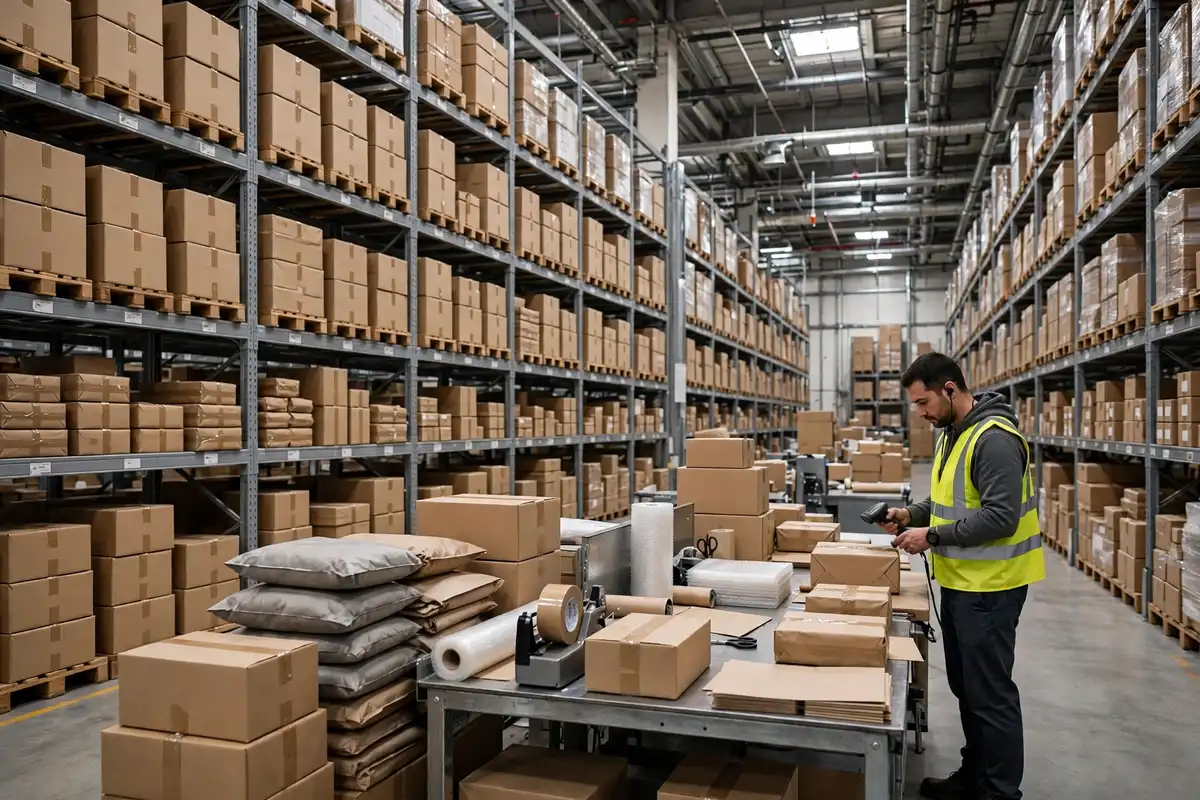
If your business ships products, there comes a point where packing boxes starts eating the hours you should spend growing it. That is exactly the problem third-party logistics exists to solve. A third-party logistics provider — usually shortened to 3PL — stores your inventory, picks and packs your orders, ships them to customers and handles returns, all under one service agreement. This guide explains how third-party logistics actually works, what it costs, and how to judge whether your business has reached the point where outsourcing fulfilment makes financial sense.
What Third-Party Logistics Actually Means
The term covers a simple idea: a specialist company performs logistics tasks on behalf of your business. At the basic end, a 3PL offers warehousing and order fulfilment — your stock sits in their building, their team packs your orders, and their carrier accounts move the parcels. More advanced providers add freight forwarding, customs handling for international shipping, inventory forecasting and even customer-service support for delivery queries.
It helps to distinguish the common labels. A courier carries parcels but stores nothing. A freight forwarder moves bulk cargo between businesses. A 3PL sits between the two and adds the warehouse layer: storage, picking, packing, labelling and returns processing. When people talk about outsourcing their fulfilment, third-party logistics is almost always what they mean.
How the Process Works Day to Day
Working with a 3PL follows a predictable rhythm. You ship your inventory to their warehouse, where it is checked in and stored — this is called inbound receiving. Your online store connects to their software, so every customer order flows straight to the warehouse team. Their staff pick the items, pack them to an agreed standard and hand the parcel to a carrier, and the tracking details flow back to your store and your customer automatically. Returns travel the same road in reverse: the 3PL receives them, inspects them and restocks or disposes of them according to your rules.
The packing standard matters more than most new sellers expect. How a parcel is protected, labelled and presented shapes the customer’s impression of your brand, not the provider’s. The principles are the same ones any careful packer follows — the methodical approach in our guide to smart packing for a long trip scales surprisingly well to a warehouse bench: protect the fragile, fill the voids, and label everything so it can be identified at a glance.
What 3PL Services Typically Cost
Third-party logistics pricing is a stack of smaller fees rather than one flat rate. Expect an onboarding or account setup fee, a receiving fee per delivery or per pallet, a monthly storage fee charged by pallet, bin or cubic metre, a pick-and-pack fee per order plus a small charge per additional item, the cost of packaging materials, and the shipping rate itself — usually better than you could negotiate alone, because the provider ships at volume. Returns processing carries its own per-item fee.
None of these fees is unreasonable, but together they mean 3PL economics depend entirely on your order volume and product size. A business shipping ten small orders a day usually gains time at a fair price. A business shipping two orders a week is often paying warehouse fees to solve a problem it does not yet have. Run the numbers on your last three months of orders before signing anything.
Signs Your Business Is Ready to Outsource
Certain symptoms show up again and again before a business makes the move. Your home, office or rented unit has become a warehouse, and stock is winning the argument for space. You spend more time printing labels and queuing at the drop-off point than on product development or marketing. Order errors creep up whenever you have a busy week, because packing is squeezed between other jobs. You want to sell into other countries but the customs and returns logistics look forbidding. Or you simply cannot take a holiday, because nobody else knows where anything is.
That last point about organisation is underrated. A business whose stock is chaotic in its own storeroom will export that chaos to the provider and pay for it in receiving delays and inventory errors. Spending a weekend imposing order first — the room-by-room discipline in our guide to decluttering your home room by room works just as well for a stockroom — makes the handover dramatically smoother.
Choosing a Provider: Questions That Matter
Treat choosing a 3PL like any other major commitment: the diligence habits in our first-time home buyer checklist — verify, itemise, and never skip the contract details — apply here too. Ask where the warehouses are, because warehouse location decides delivery speed and shipping cost to your main customer regions. Ask how their software integrates with your store, how inventory counts are verified, and what happens when their count and yours disagree. Ask for their error rate, their cut-off times for same-day dispatch, and exactly how returns are graded. Visit the site if you possibly can; a tidy, calm warehouse with labelled locations is worth more than a polished sales presentation.
Finally, read the exit terms before you sign the entry terms. How much notice ends the contract, and what does it cost to have your remaining stock shipped back to you? A confident provider answers these questions plainly.
The International Angle
One of the strongest arguments for third-party logistics is expansion. A provider with warehouses in two countries lets you hold stock close to foreign customers without opening a foreign office, and their customs experience turns an intimidating paperwork exercise into a routine process. If you are preparing to sell into a new market, remember that logistics is only half the localisation task — the other half is language and presentation, and our guide to learning a new language as an adult is a realistic starting point if you plan to support those customers yourself.
So, Should You Outsource?
Third-party logistics is neither a shortcut for beginners nor a luxury for giants; it is a tool for the middle stage, when order volume has outgrown your spare room but not yet justified your own warehouse team. If packing is consuming your best hours, errors rise with every promotion, and the fee stack still leaves your margins healthy, outsourcing will probably feel like hiring a whole department overnight. If your volume is small, keep fulfilling in-house, build tidy habits — the same steady-routine thinking behind our beginner’s guide to starting a running routine applies to operations more than people expect — and revisit the decision when the numbers change. The right time to outsource is when the sums, not the stress alone, say so.