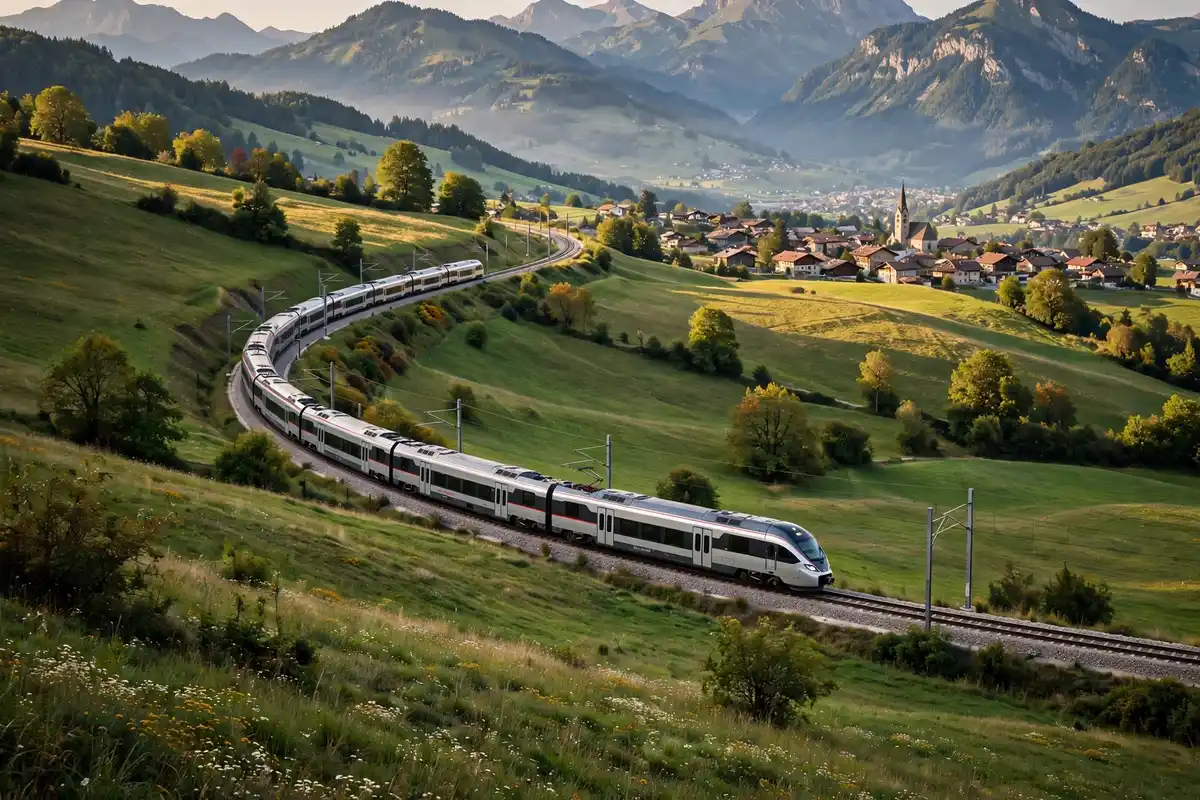
There is a moment on every great European rail journey when the trip stops feeling like transport and starts feeling like the holiday itself: the city slips away, fields and rivers take over the window, and someone across the aisle opens a coffee as the train settles into its rhythm. Train travel in Europe is extensive, comfortable and far simpler than first-timers expect — one connected network links grand capitals, small towns and mountain villages, often delivering you straight into the centre of the place you came to see. This beginner’s guide explains how the system works, how to choose tickets and passes, and how to travel by rail with confidence from your very first journey.
Why the Train Suits Europe So Well
Europe’s geography was made for rail. Distances between major cities are moderate, stations sit in city centres rather than on distant outskirts, and on many routes the train is genuinely faster door-to-door than flying once airport travel, security and waiting are counted. High-speed networks in France, Spain, Germany, Italy and beyond have turned journeys of four or five hours by road into two relaxed hours by rail. Just as importantly, trains remove the stress points of other transport: no parking, no navigating foreign road rules, no luggage carousels — and the scenery, from Alpine valleys to coastal lines, becomes part of the trip rather than something you fly over. Travellers who enjoy this slower, more connected style often pair rail journeys with the approaches in our solo travel tips for first-time travellers.
Pass or Point-to-Point Tickets?
The first decision is how to pay. Rail passes, such as the Interrail pass for European residents and the Eurail pass for visitors from elsewhere, allow flexible travel across many countries for a set number of travel days within a period. They shine when your plans are open, your route covers several countries, or you love the freedom to change your mind. Point-to-point tickets, bought for a specific train, are often cheaper when booked early, especially on popular high-speed routes where advance fares can be dramatically lower than walk-up prices. A good rule of thumb: the more fixed your itinerary and the earlier you can book, the more point-to-point tickets win; the more spontaneous the trip, the more a pass earns its keep. Some high-speed and night trains require seat reservations on top of a pass, so check each route as you plan.
Booking, Classes and Seat Reservations
Book through the national railway of the country where each journey starts, or through reputable cross-border booking platforms that sell multiple operators in one place. Second class in Europe is comfortable — proper seats, power sockets on most modern trains, luggage space and a buffet car or trolley on longer routes. First class brings wider seats, quieter carriages and sometimes food and drink included, and on advance fares the upgrade can cost surprisingly little. When you reserve, pay attention to seat choices: window for the scenery, aisle for restlessness, and quiet cars if you plan to rest or work. On scenic routes the side of the train can matter too, though staff and fellow passengers are usually happy to share local knowledge.
Stations, Luggage and Life on Board
Arrive at the station about twenty minutes before departure — enough to find your platform on the departure boards, buy supplies and board calmly. Platforms are usually announced well in advance, and trains often open for boarding several minutes before leaving. Luggage travels with you: racks sit at the ends of carriages and above seats, and since you handle your own bags, packing light pays off — our smart packing tips for a long trip were written with exactly this kind of journey in mind. On board, settle in: most long-distance trains have a café or restaurant car, many have Wi-Fi, and all have the great railway pleasure of being able to walk around whenever you like. Keep tickets and ID accessible, because inspections happen during the journey rather than at a gate.
Night Trains and Scenic Routes Worth Seeking Out
Night trains turn travel time into hotel time. Routes across Austria and its neighbours, through Scandinavia and between major capitals offer a choice of reclining seats, couchettes shared with a few travellers, or private sleeper cabins with beds made up for you. Waking in a new country as breakfast arrives is one of travel’s great pleasures. By day, some lines are destinations in themselves: the Alpine crossings of Switzerland, the West Highland Line in Scotland, the coastal stretches of the French and Italian Riviera, and Norway’s mountain railways all reward a window seat. After the grand scale of rail travel, the slow drift of wandering the canals of Venice — a city with no roads at all — makes a perfect counterpoint at the end of a journey.
First-Timer Mistakes to Avoid
A few classic errors are easy to sidestep. Do not assume a pass covers every train without a reservation, and do not leave high-speed bookings to the last day in peak summer. Validate or activate tickets and passes exactly as instructed, since fines for honest mistakes are a miserable start to a holiday. Watch your connection times: ten minutes is fine at a small station, tight at a huge one. Keep an eye on your belongings at busy stations, as you would anywhere crowded. Finally, learn the handful of railway words that matter in each country — departure, platform, delay — a small effort that fits the advice in our guide on how to learn a new language and makes every noticeboard easier to read. Do that, and the network opens up: Europe by train is not just a way to travel, it is one of the best reasons to go.