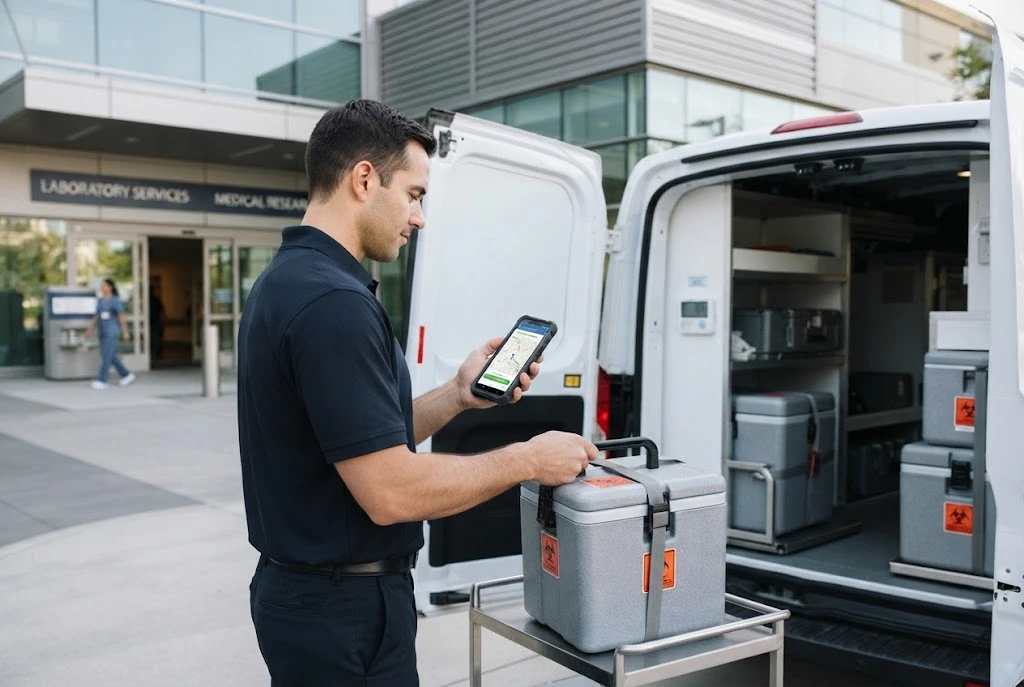
Unlike ordinary delivery applications, medical logistics workflows often require greater attention to timing, chain-of-custody procedures, specimen handling instructions, communication, and documentation. When these activities are coordinated through disconnected phone calls, paper records, and manual updates, operational teams can have difficulty maintaining visibility across every stage of a delivery.
A purpose-built driver application can help address those challenges by giving drivers clear assignments while giving dispatchers and laboratory teams better visibility into transportation activity. This makes mobile logistics technology an important part of modern logistics operations and healthcare support systems.
What Is a Lab Logistics Driver App?
A lab logistics driver app is a mobile application designed to support drivers who transport laboratory specimens, medical materials, supplies, or other healthcare-related deliveries. Depending on the system, it may connect drivers with dispatchers, laboratory staff, transportation coordinators, and administrative teams.
The objective is not simply to provide GPS navigation. A well-designed application can organize the entire delivery workflow, from assignment and pickup instructions to status updates, proof of delivery, exception reporting, and operational records.
This type of technology sits at the intersection of supply chain management, transportation coordination, healthcare operations, and mobile technology.
Why Medical Transport Requires Specialized Logistics
Medical transportation can involve requirements that are different from conventional parcel delivery. A shipment may have a defined pickup window, specific handling instructions, a designated receiving location, and documentation requirements that must be followed carefully.
For laboratories, the transportation process is also connected to broader operational workflows. A delay, missed pickup, incomplete handoff, or communication problem can create additional work for staff and make it harder to maintain predictable service.
That is why healthcare organizations increasingly benefit from systems that provide greater visibility and coordination across transportation activities. Broader healthcare operations can also be supported by technologies discussed in resources such as healthcare service operations and health and wellness technology.
Core Features of a Lab Logistics Driver App
1. Digital Delivery Assignments
Drivers need clear information about what they are expected to collect or deliver. A driver application can display assigned jobs, pickup and destination details, timing information, notes, and priority instructions in one place.
Digital assignments reduce dependence on scattered messages and make it easier for drivers to review their work while dispatch teams maintain a centralized view of active transportation tasks.
2. Real-Time Location Visibility
GPS-based location tracking can provide dispatchers with a current view of vehicle activity. Instead of relying entirely on phone calls to determine where a driver is, transportation teams can use application-based location information to understand progress throughout a route.
Location visibility becomes particularly useful when multiple pickups and deliveries are taking place simultaneously. It can help teams identify potential delays and communicate with affected parties more efficiently.
Similar principles of operational visibility apply across the broader logistics industry, including the supply-chain approaches discussed in FBB Logistics and supply chain efficiency.
3. Route Planning and Navigation
Medical drivers may need to visit multiple facilities during a shift. Route planning features can help organize stops, provide navigation support, and make changing delivery priorities easier to manage.
Good routing is about more than choosing the shortest distance. Dispatchers may need to consider delivery windows, traffic conditions, vehicle availability, pickup priorities, and the sequence of locations.
For businesses interested in the wider relationship between transportation and logistics efficiency, travel distance and logistics efficiency provides another related perspective.
4. Pickup and Delivery Status Updates
A driver application can provide structured status options such as assigned, en route, arrived, picked up, delivered, delayed, or exception reported. These updates create a clearer operational timeline than informal phone-based communication.
Laboratory staff can use status information to understand where a delivery stands, while dispatchers can identify jobs that require attention.
5. Digital Proof of Delivery
Proof of delivery can be an important component of medical transportation workflows. Depending on the organization’s requirements, an application may support signatures, timestamps, delivery confirmations, photographs, notes, or other digital records.
Maintaining these records digitally can make it easier for authorized teams to review completed transportation activities and investigate exceptions when necessary.
Improving Communication Between Drivers and Laboratories
Communication is one of the most important parts of medical transportation. Drivers may encounter traffic congestion, incorrect addresses, facility access issues, scheduling changes, or other unexpected circumstances.
A connected application can give drivers and dispatchers a structured way to communicate these issues. Instead of repeatedly switching between phone calls, text messages, and separate systems, teams can keep relevant updates closer to the transportation workflow.
This approach also supports better accountability. When updates are associated with specific assignments, organizations can develop a clearer operational history for individual deliveries.
Handling Exceptions in Medical Transportation
No transportation operation is completely free of disruptions. A driver may arrive at a location and find that the receiving department is unavailable. A pickup may be delayed, a route may become inaccessible, or an instruction may change after a vehicle is already in transit.
A lab logistics driver app can provide structured exception workflows so drivers know how to report these situations. Dispatch teams can then decide what action is appropriate rather than discovering the problem only after a delivery deadline has passed.
Exception management is particularly valuable for organizations operating across multiple locations because centralized visibility becomes harder as transportation volume grows.
Chain of Custody and Documentation
Medical transportation often requires careful documentation of handoffs. The exact procedures depend on the type of material being transported and the organization’s operational and regulatory requirements, but digital workflows can make documentation more consistent.
A driver app may record events such as pickup time, arrival time, delivery time, user actions, and confirmation details. These records can provide an auditable operational trail for authorized personnel.
Digital documentation can also complement broader inventory and resource-management practices. For example, the principles discussed in inventory management systems demonstrate how structured digital records can support better visibility over operational resources.
Integration With Healthcare and Business Systems
The value of a driver app increases when it can fit into an organization’s existing technology environment. Depending on the implementation, integrations may connect transportation information with scheduling platforms, laboratory systems, dispatch software, billing workflows, or reporting tools.
Integration can reduce duplicate data entry and make it easier for different departments to work from consistent information. It can also create opportunities for organizations to analyze transportation performance alongside other operational metrics.
Healthcare organizations already use a wide range of digital platforms, from administrative systems to specialized clinical technologies. Related discussions around health technology solutions illustrate the broader role technology plays in modern healthcare environments.
Data and Analytics for Logistics Managers
A modern driver app can generate useful operational data. Depending on the platform, managers may be able to review completed deliveries, travel patterns, delays, driver activity, exceptions, and workload distribution.
The purpose of analytics should not be to collect data simply for the sake of having dashboards. Useful reporting should help answer practical questions:
- Where are recurring transportation delays occurring?
- Which routes create operational challenges?
- Are workloads distributed effectively?
- How frequently are delivery exceptions reported?
- Which locations require additional coordination?
- Where can scheduling or routing processes be improved?
These insights can support continuous improvement and help logistics managers make decisions using operational evidence rather than assumptions.
Scalability for Growing Medical Networks
A transportation workflow that works for a small laboratory may become difficult to manage when the organization expands into multiple facilities or regions. More drivers, more pickup locations, and more delivery requirements increase coordination complexity.
A scalable driver application can provide a centralized operational layer while allowing organizations to expand the number of users, routes, vehicles, and facilities supported by the system.
Scalability is also important when logistics providers serve different types of customers. Broader freight networks, for example, may involve many locations and transportation partners, as explored in global freight operations.
Security and Access Control
Healthcare-related transportation systems can involve operational information that should only be accessible to authorized users. Security therefore needs to be considered when selecting or developing a lab logistics driver app.
Organizations should evaluate authentication, user permissions, data protection, device security, access logging, and administrative controls according to their own requirements.
The application should also minimize unnecessary exposure of sensitive information. Drivers generally need the information required to complete their assigned transportation tasks, while administrative users may require broader reporting and management capabilities.
How a Lab Logistics Driver App Supports Drivers
Technology should make transportation work easier rather than adding unnecessary complexity. A driver application can provide one location for assignments, navigation, status updates, delivery instructions, and communication.
A well-designed interface can reduce the amount of manual coordination required during a busy route. Clear workflows also help drivers understand what action is expected at each stage of a delivery.
This principle applies to logistics operations beyond healthcare as well. Freight logistics workflows similarly depend on clear coordination between drivers, dispatchers, customers, and operational teams.
Choosing the Right Lab Logistics Driver App
Healthcare organizations should evaluate a transportation application based on their actual operational requirements rather than selecting a platform solely because it has a long feature list.
Important evaluation criteria can include:
- Ease of use for drivers and dispatchers
- GPS and route-management capabilities
- Delivery status tracking
- Digital proof-of-delivery functionality
- Exception and incident reporting
- Communication tools
- Reporting and analytics
- User permissions and security controls
- Integration capabilities
- Scalability across additional locations
- Technical support and system reliability
Organizations should also consider how the application fits into their broader technology strategy. Digital transformation is most effective when individual tools support a coherent workflow rather than creating another isolated system.
Lab Logistics Apps and the Future of Medical Transportation
Medical transportation is becoming increasingly connected. Mobile applications, GPS tracking, digital records, automated notifications, analytics, and system integrations can work together to create more visible transportation workflows.
The long-term opportunity is not simply replacing paper delivery logs with a smartphone application. It is creating a connected logistics environment in which transportation information can move efficiently between drivers, laboratories, healthcare facilities, dispatch teams, and management.
Other logistics technologies are moving in the same direction. For example, the lab logistics driver app concept can be viewed alongside broader discussions of logistics efficiency and global supply chain operations.
Related Healthcare Technology Considerations
Transportation does not operate in isolation from the rest of healthcare. Laboratories and healthcare organizations rely on staffing, facilities, insurance, technology, inventory, and patient-support systems working together.
For example, readers exploring healthcare operations may also find value in resources covering health insurance solutions, behavioral healthcare, and specialized healthcare services.
These areas are different from medical transportation, but they demonstrate why modern healthcare organizations increasingly depend on connected operational systems.
Frequently Asked Questions About Lab Logistics Driver Apps
What does a lab logistics driver app do?
It helps coordinate medical transportation activities by providing drivers with assignments, navigation, status updates, delivery instructions, communication tools, and documentation features.
Can a lab logistics app track drivers?
Many transportation applications can use GPS-based tracking to provide location visibility. The exact functionality depends on the platform and its configuration.
Why is route optimization important for laboratory transportation?
Route planning can help drivers organize multiple stops and respond more effectively to traffic, scheduling changes, and delivery priorities.
Can these apps provide proof of delivery?
Depending on the application, proof-of-delivery features may include timestamps, signatures, delivery confirmations, notes, or other digital records.
Can a driver app integrate with other systems?
Some platforms support integrations with scheduling, laboratory, dispatch, billing, reporting, or other business systems. Integration capabilities should be evaluated before selecting a solution.
Are lab logistics driver apps only useful for large healthcare organizations?
No. Smaller laboratories may also benefit from structured digital workflows. The appropriate system depends on transportation volume, operational complexity, staffing, and technology requirements.
Final Takeaway
A lab logistics driver app can transform medical transportation from a collection of disconnected activities into a more organized and visible digital workflow. Real-time location information, digital assignments, route planning, status updates, communication, documentation, analytics, and scalable integrations can all contribute to better transportation coordination.
The most valuable application is not necessarily the one with the most features. It is the one that fits the organization’s workflow, supports drivers and dispatch teams, provides useful operational visibility, and can scale as transportation requirements change.
As healthcare logistics becomes increasingly technology-driven, connected mobile tools will continue to play an important role in helping laboratories and healthcare organizations coordinate time-sensitive transportation with greater clarity and consistency.